Motor Overload Relay Setting Guide: FLA, Service Factor and Trip Class
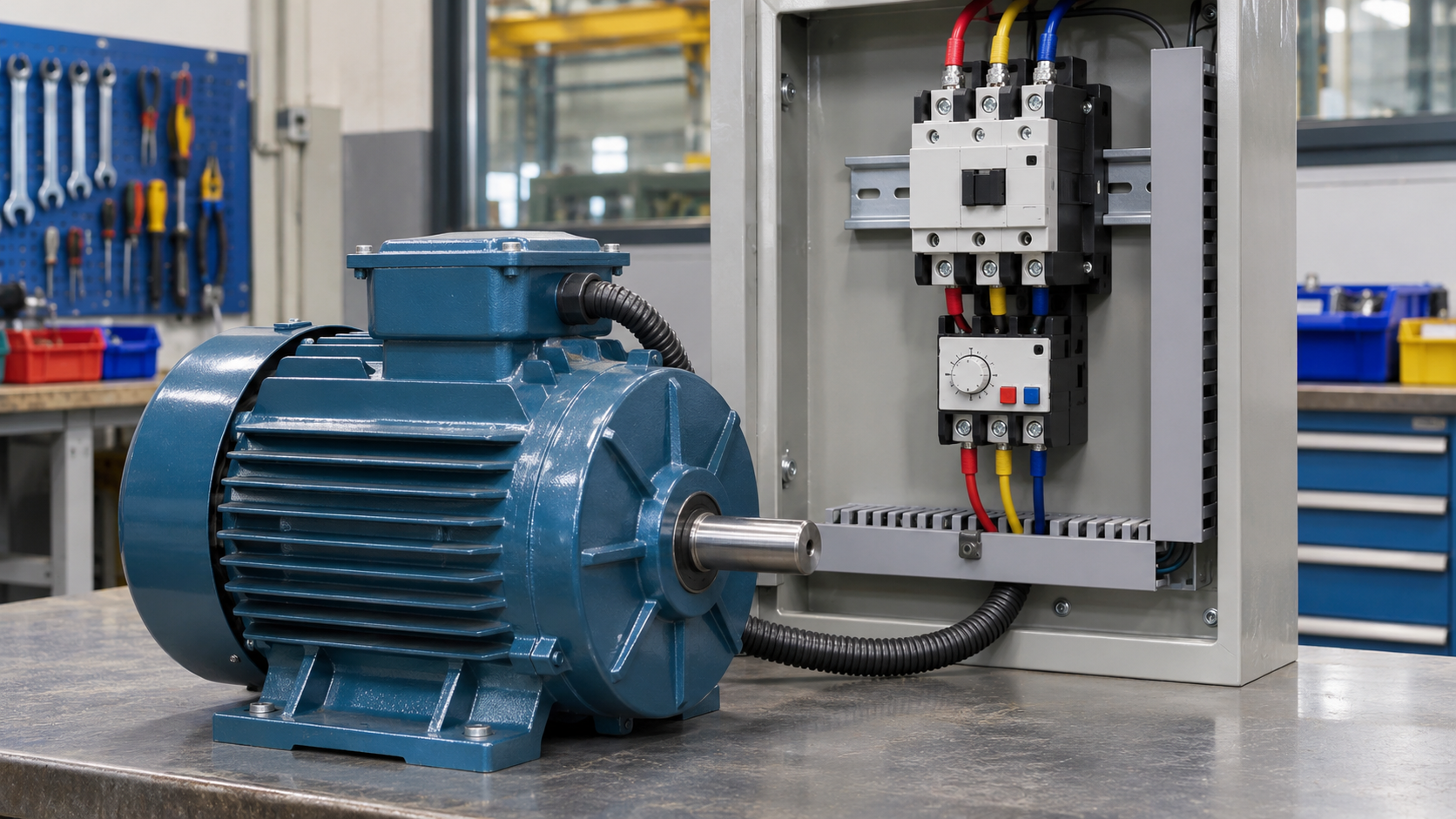
Quick answer: set a motor overload relay from the motor nameplate current and the manufacturer’s application instructions—not from the contactor rating. Then choose a trip class that allows normal acceleration but operates before the motor exceeds its permissible thermal limit.
What an overload relay protects
An overload relay protects a motor against sustained overcurrent, excessive starting time, locked rotor and—in an electronic relay—conditions such as phase loss or current imbalance. It models heating rather than interrupting high short-circuit current. A fuse, MCCB or motor-protection circuit breaker is still required for short-circuit protection.
Motor overload setting workflow
- Record rated voltage, full-load current, frequency, service factor, duty and insulation class from the nameplate.
- Confirm the actual starter connection. In star-delta arrangements, relay location changes the current seen by the relay.
- Select a relay adjustment range that places the required setting away from the extreme ends of the dial.
- Set pickup according to the motor and relay manufacturer’s instructions and the applicable code.
- Choose the trip class from measured acceleration time and motor locked-rotor withstand.
- Verify phase-loss sensitivity, reset mode, restart interlocks and coordination with upstream protection.
Worked setting example
Consider a 30 kW, 400 V motor with a nameplate full-load current of 56 A and a measured starting time of 5 seconds. Choose an overload relay whose range comfortably includes 56 A. A preliminary setting begins at the nameplate current, subject to the manufacturer’s factor for service factor and ambient conditions.
If the motor accelerates normally in 5 seconds and the hot locked-rotor withstand exceeds the relay operating time, a Class 10 relay is a reasonable starting point for review. A high-inertia fan taking 16 seconds to accelerate may require Class 20, but only after checking the motor thermal curve. Increasing trip class simply to stop nuisance trips can leave the motor unprotected.
Trip classes explained
| Trip class | Typical application | Main caution |
|---|---|---|
| Class 5 | Fast-starting, thermally sensitive motors | May trip during longer acceleration |
| Class 10 | General-purpose motors with normal starts | Confirm hot-start margin |
| Class 20 | Higher-inertia loads and longer starts | Check motor locked-rotor withstand |
| Class 30 | Very long acceleration under engineered conditions | Not a cure for mechanical overload or low voltage |
Common setting mistakes
- Using motor kW alone instead of nameplate current.
- Setting the relay to the contactor or cable ampacity.
- Ignoring ambient temperature and enclosure heating.
- Choosing a slow trip class without the motor thermal curve.
- Failing to account for relay position in a star-delta starter.
- Allowing automatic restart where unexpected movement is hazardous.
Motor Overload Relay FAQ
Should the overload equal motor full-load current?
Nameplate current is the normal starting point, but the final setting must follow the motor, relay and code requirements, including service factor and installation conditions.
Does an overload relay protect the cable?
It contributes to overload protection of the motor circuit, but cable short-circuit protection depends on the upstream protective device and verified energy let-through.
Why does a motor trip after several minutes?
Likely causes include mechanical overload, low or unbalanced voltage, phase loss, frequent starts, poor ventilation, high ambient temperature or an incorrect relay setting.
Continue with the motor nameplate guide and motor starter troubleshooting checklist.