Public EV Charging Checklist: Compatibility, Pricing and Waiting Time

A station advertised at 350 kW does not guarantee that your car will receive 350 kW—or that a compatible connector will be available when you arrive. A reliable charging stop depends on connector compatibility, vehicle limits, battery state, live station status, power sharing, payment and total time including any queue.
Check these five items before departure
- Connector: confirm the plug and vehicle compatibility from current operator and vehicle information.
- Live status: distinguish operational connectors from those occupied or out of service.
- Payment: know whether card, contactless, app, RFID or contract authentication is available.
- Price: review energy, session, time, roaming and occupancy components.
- Backup: identify a second site reachable with a safe reserve.
A location, charging point and connector are different
A map pin may represent a site with several charging points, and one point may have more than one cable. Two cables do not necessarily mean two cars can charge simultaneously. Learn the operator’s terminology and inspect live connector-level data where available.
| Term | Practical meaning | Common mistake |
|---|---|---|
| Location or station | The physical charging site | Counting one map pin as one connector |
| Charging point or port | Equipment able to serve one vehicle at a time | Assuming every cable is independent |
| Connector | The plug presented to the vehicle | Ignoring vehicle compatibility |
| Pool | Multiple points at one location | Ignoring a shared site power limit |
Connector compatibility by region
European public AC charging commonly uses Type 2, while European DC charging commonly uses CCS Combo 2, with some CHAdeMO infrastructure remaining. North American connector deployment differs and is changing. Gulf networks may contain equipment aligned with different regional vehicle imports. Always verify the actual vehicle inlet, any manufacturer-approved adapter and the station listing.
An adapter does not automatically make a station usable. Authentication, communication protocol, voltage, current and operator policy must also be compatible. Do not use unapproved accessories or bypass protective messages.
Station power versus vehicle power
Actual charging power is limited by the weakest link: station output, connector/cable rating, vehicle maximum, battery voltage, temperature, state of charge and the vehicle’s charging curve. A 150 kW car cannot take 350 kW simply because the station can deliver it.
Power also changes during the session. Many EVs charge fastest at lower or middle SOC and taper as the battery fills. Compare a meaningful 10–80% time or energy delivered, not only the brief peak displayed.
Worked charging-time estimate
Suppose a car needs 42 kWh added. If average power during the useful window is 84 kW, ideal transfer time is 42 ÷ 84 = 0.5 hours, or 30 minutes. If the station is shared and average power drops to 60 kW, transfer time becomes 42 minutes. Add connection, authentication, queue and departure time to estimate the real stop.
| Stage | Scenario A | Scenario B |
|---|---|---|
| Energy required | 42 kWh | 42 kWh |
| Average charging power | 84 kW | 60 kW |
| Energy-transfer time | 30 min | 42 min |
| Queue | 0 min | 20 min |
| Approximate stop before overhead | 30 min | 62 min |
Shared-power architecture
A site may dynamically distribute a cabinet’s capacity across several dispensers. Two vehicles can receive unequal power because their requests, SOC, temperature and priority differ. A 200 kW cabinet serving two connectors does not imply a permanent 100/100 split.
Look for site-level and point-level ratings. If a trip depends on a fast stop, use recent operational data but retain a backup because availability and sharing can change after departure.
Understand every price component
- Energy charge per kWh
- Time charge per minute
- Session or connection fee
- Occupancy or idle fee after charging
- Parking fee
- Subscription or roaming price difference
- Temporary card authorization hold
In the EU, the Alternative Fuels Infrastructure Regulation requires transparent ad-hoc pricing. At publicly accessible points of 50 kW or more, the ad-hoc price is based on price per kWh, and any occupancy fee is expressed per minute and shown before the session. Requirements vary outside the EU, so check the operator’s current terms.
Ad-hoc payment versus charging contracts
Ad-hoc charging means starting without a prior charging-service contract. A contract or mobility-service app can still be useful for discounts, roaming or fleet records. Compare the final price; the same station can display different costs through the operator and a roaming provider.
Before relying on one app, confirm mobile coverage, login access and payment method. Keep the operator support number and charging-point identifier available.
Build a backup stop into the route
A backup should be reachable after arriving at the first station and discovering it is unusable. Calculate reserve from the first station, not from the original departure point. Consider weather, elevation, speed and detours.
| Check | Primary site | Backup site |
|---|---|---|
| Arrival SOC | Planned value | Value after diversion |
| Compatible points | Number operational | Number operational |
| Opening/access | 24/7 or restricted | 24/7 or restricted |
| Payment | Verified method | Independent method preferred |
| Support | Operator contact | Operator contact |
Arrival inspection and safe connection
Park without blocking adjacent bays. Inspect the cable and connector for obvious damage, contamination or excessive strain. Follow station and vehicle instructions; do not use damaged equipment. Connect fully, authenticate and confirm that the car and station both show an active session.
Never attempt to repair public charging equipment. If a point fails, record its identifier and contact the operator or use the planned alternative.
Monitor the first minutes
Confirm energy is increasing and no fault appears. Low initial power may be normal while the vehicle and charger negotiate or while a cold battery warms. If power remains unexpectedly low, check whether the station is sharing capacity and whether the vehicle shows a limitation.
Do not repeatedly stop and restart a session solely to chase a peak number. Use the operator’s support process when the equipment behaves abnormally.
Stop at the useful SOC
For many trips, charging from low SOC to the required reserve is faster than filling to 100%, because power tapers near the top. The best departure SOC depends on distance to the next reliable charger, conditions, vehicle efficiency and desired reserve.
Move the car promptly after the session. Idle or occupancy fees may apply, and the point is needed by other drivers.
Check the receipt
Record station and connector ID, start and end time, start and end SOC, energy delivered, price components and total cost. Separate queue time from connection time and energy-transfer time. This makes later route comparisons meaningful.
If the receipt appears wrong, keep screenshots and the operator’s session reference. Do not use the dashboard SOC change alone as an exact meter of energy delivered because vehicle display rounding and charging losses differ.
Fast pre-trip checklist
- Compatible connector and vehicle access confirmed
- Live point availability checked
- Station and shared-power limits understood
- Payment and complete price reviewed
- Vehicle battery preconditioned when supported
- Primary and backup arrival SOC calculated
- Operator support details saved
- Receipt and session data retained
Related EV guides
Use the EV road-trip reserve example, learn why average power matters more than peak power, and review winter range data.
Official sources and image credit
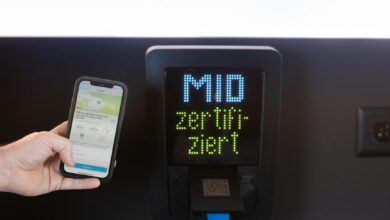
See EU Regulation 2023/1804 for European public-charging pricing and payment requirements, and the U.S. Alternative Fuels Data Center for charging terminology and connector guidance. Photo by JUICE under the Unsplash License. Original educational content by ST College.