Understanding Power Swing in Power Systems
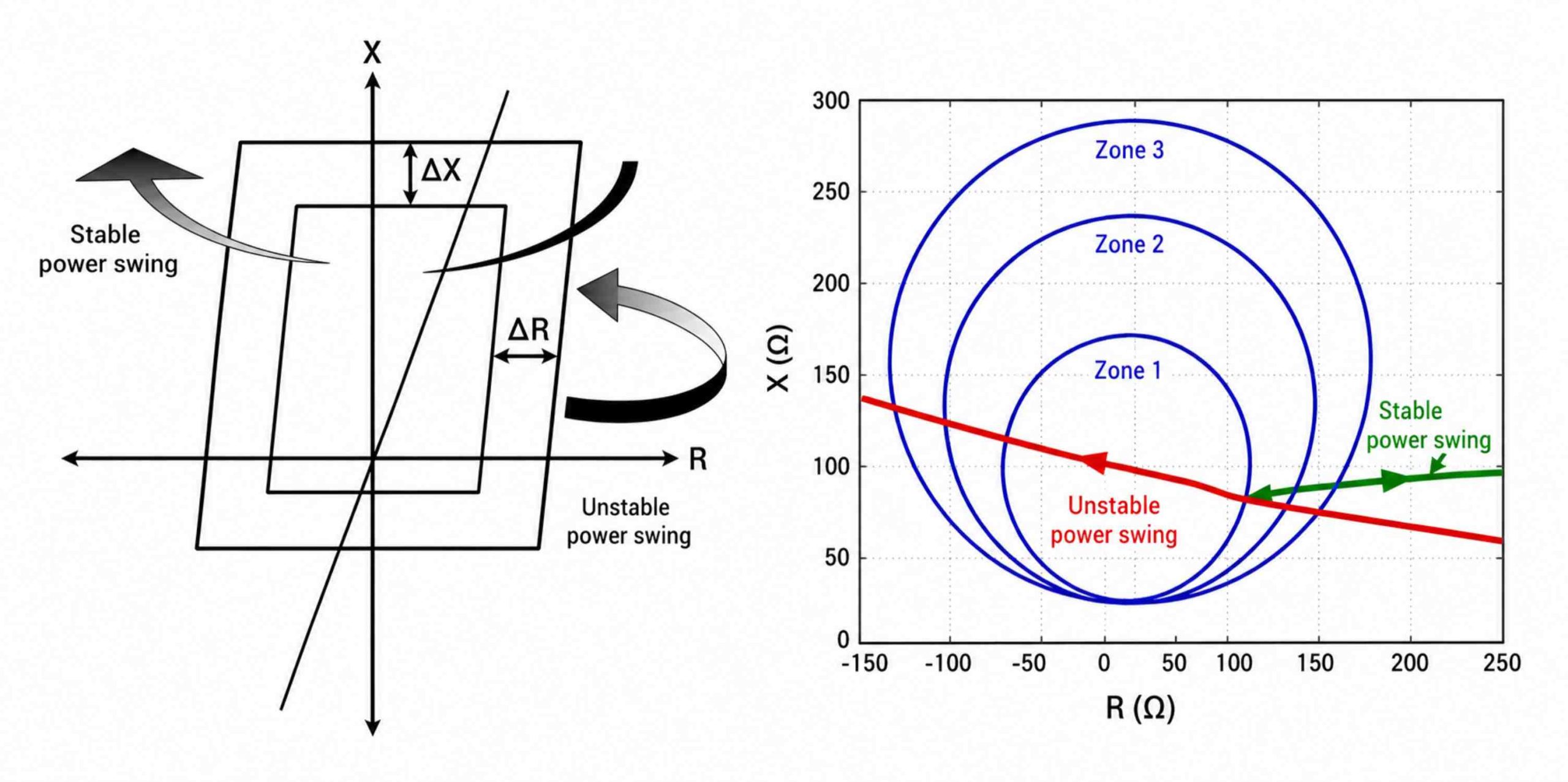
Power systems are inherently dynamic. Whenever a disturbance such as a short circuit, a sudden load change, or a switching operation occurs, system variables like voltage, current, and impedance do not settle immediately. Instead, they oscillate for a short duration before reaching a new steady state. This oscillatory behavior is known as a power swing.
What is a Power Swing?
A power swing occurs when there is a temporary imbalance between mechanical input power and electrical output power in generators. This imbalance causes the rotor angles of generators to accelerate or decelerate relative to each other.
As a result:
- Power flow in the network fluctuates.
- Apparent impedance seen by protection relays changes continuously.
- The system may either stabilize or lose synchronism depending on the severity of the disturbance.
Power swings are not faults. They are a natural response of the system to disturbances.
Causes of Power Swings
Power swings can be triggered by several events, including:
- Faults (short circuits) that are cleared after a short time
- Sudden large load changes
- Line switching operations
- Generator tripping or sudden generation loss
- System disturbances due to grid interconnections
After such events, the system attempts to regain equilibrium, leading to oscillations.
Stable vs Unstable Power Swing
Power swings can be broadly classified into two types:
1. Stable Power Swing
- The system remains synchronized.
- Oscillations gradually decrease with time.
- The system returns to normal operating conditions.
2. Unstable Power Swing
- The system loses synchronism.
- Oscillations increase or do not settle.
- This may lead to system separation or blackout.
On the R–X (resistance-reactance) plane, these swings appear as trajectories moving through relay zones. Stable swings remain controlled, while unstable swings cross critical boundaries.
Power Swing and Distance Protection
Distance relays operate based on the impedance seen from the relay location. During a power swing:
- The apparent impedance changes continuously.
- This trajectory may enter relay operating zones.
- The relay may misinterpret this as a fault and trip incorrectly.
This is why power swing blocking (PSB) is essential in protection schemes—to prevent unnecessary tripping during non-fault conditions.
Conditions for Detecting Power Swing
To correctly identify a power swing and avoid false tripping, certain conditions must be verified:
• No Earth Fault Detection
- There is no zero-sequence current.
- Indicates absence of ground faults.
• No Phase-to-Phase Fault
- There is no negative-sequence current.
- Confirms no unbalanced fault between phases.
• Three-Phase Impedance Change
- The impedance change occurs uniformly across all three phases.
- The rates of change of impedance (ΔR and ΔX) are slow and remain within a defined threshold.
This slow, smooth variation distinguishes power swings from faults, which typically cause abrupt changes in impedance.
Power Swing Blocking (PSB)
Modern protection systems use Power Swing Blocking (PSB) logic to prevent relay maloperation.
Key features:
- Detects slow impedance movement across relay characteristics
- Blocks tripping during stable swings
- Allows tripping if an actual fault occurs during the swing (using Power Swing Unblocking)
Why Power Swing Detection is Important
Accurate detection of power swings is critical for:
- System Stability: Prevents unnecessary disconnection of healthy lines
- Reliability: Ensures that protection operates only for real faults
- Equipment Protection: Reduces stress on circuit breakers and relays
- Grid Security: Avoids cascading failures and blackouts
Conclusion
Power swing is a natural and unavoidable phenomenon in power systems following disturbances. While it reflects the system’s effort to regain stability, it can pose challenges for protection schemes—especially distance relays. By distinguishing between actual faults and power swings using conditions like the absence of sequence currents and controlled impedance variation, modern protection systems ensure secure and reliable operation. Understanding power swings is therefore essential for engineers working in power system protection and stability analysis.