A Practical Guide to Transformer Testing Standards
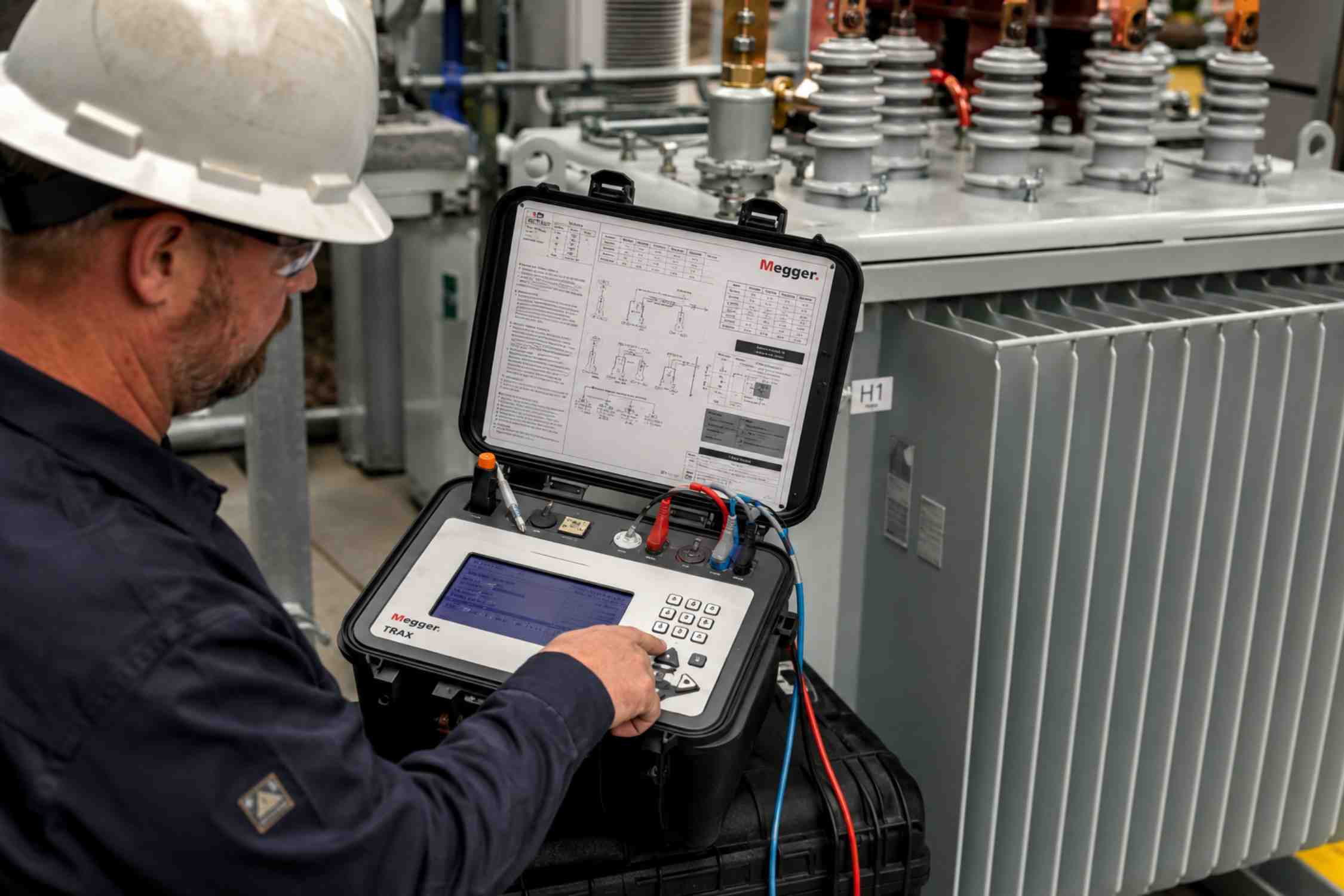
Transformers are one of the most important pieces of equipment in any electrical system. Whether newly manufactured or fully remanufactured, every transformer must undergo a series of tests to ensure it can operate safely, efficiently, and reliably in the field.
These tests help manufacturers verify build quality, identify hidden defects, and ensure compliance with industry standards such as IEEE C57.12.00 and IEEE C57.12.90 for liquid-filled transformers, and IEEE C57.12.01 and IEEE C57.12.91 for dry-type transformers.
In this guide, we’ll break down the most common transformer tests, explain what each test measures, and show why these tests matter in real-world applications.
Why Transformer Testing Matters
Transformer testing serves two main purposes:
- Quality assurance during manufacturing
- Condition assessment during repair, remanufacturing, or field service
Some tests confirm that the transformer was built correctly. Others help detect issues like insulation breakdown, winding damage, loose connections, or excessive losses before the transformer is energized in service.
Testing is typically grouped into three categories:
1. Routine Tests
Routine tests are standard pass/fail tests performed on every transformer before it leaves the factory.
2. Design Tests
Design tests are performed on the first unit of a specific design to verify that the transformer meets performance and rating requirements.
3. Other or Diagnostic Tests
These are optional or customer-requested tests often used for troubleshooting, condition monitoring, or special applications.
Standard Transformer Tests by Transformer Type
| Test Performed | 600V Dry | MV Dry | Distribution 3-Phase Liquid | Class I Power Substation |
|---|---|---|---|---|
| Transformer Turns Ratio (TTR) | ✓ | ✓ | ✓ | ✓ |
| Winding Resistance | ✓ | ✓ | ✓ | ✓ |
| Impedance Voltage & Load Loss | ✓ | ✓ | ✓ | |
| Polarity / Phase Relation | ✓ | ✓ | ✓ | |
| Excitation & No-Load Loss | ✓ | ✓ | ✓ | |
| Insulation Resistance (Megger) | ✓ | ✓ | ✓ | ✓ |
| Insulation Power Factor | ✓ | |||
| Leak Test | ✓ | ✓ |
Routine Factory Tests for New Transformers
Routine tests are performed on every transformer before shipment to ensure the unit meets IEEE manufacturing standards.
| Routine Test | 600V Dry | MV Dry | Dist. 3-Ph Liquid | Class I Power Sub |
|---|---|---|---|---|
| Transformer Turns Ratio (TTR) | ✓ | ✓ | ✓ | ✓ |
| Winding Resistance | ≥ 300 kVA | ≥ 300 kVA | > 2500 kVA | |
| Impedance Voltage & Load Loss | ✓ | ✓ | ✓ | ✓ |
| Polarity / Phase Relation | ✓ | ✓ | ✓ | ✓ |
| Excitation & No-Load Loss | ✓ | ✓ | ✓ | ✓ |
| Applied Voltage | ✓ | ✓ | ✓ | |
| Induced Voltage | ✓ | ✓ | ✓ | |
| Lightning Impulse | ✓ | |||
| Insulation Resistance | ≥ 300 kVA | ≥ 300 kVA | ✓ | |
| Insulation Power Factor | ✓ | |||
| Leak Test | Sealed Units | Sealed Units | ✓ | ✓ |
| Operation Test of Devices | ✓ | ✓ | ||
| Dielectric Withstand (Hipot) | ✓ |
Design Tests for New Transformers
Design tests are typically performed on the first transformer of a particular design to validate performance under operating conditions.
| Design Test | 600V Dry | MV Dry | Dist. 3-Ph Liquid | Class I Power Sub |
|---|---|---|---|---|
| Winding Resistance | < 300 kVA | < 300 kVA | ≤ 2500 kVA | |
| Lightning Impulse | ✓ | ✓ | ✓ | ✓ |
| Temperature Rise | ✓ | ✓ | ✓ | ✓ |
| Audible Sound Level | ✓ | ✓ | ✓ | ✓ |
| Short-Circuit Capability | ✓ | ✓ | ||
| Pressure Test | Sealed Units | Sealed Units | ✓ | ✓ |
| Leak Test | ✓ | ✓ |
Other / Diagnostic Transformer Tests
These tests are often requested for troubleshooting, field diagnostics, or specialized applications.
| Other Test | 600V Dry | MV Dry | Dist. 3-Ph Liquid | Class I Power Sub |
|---|---|---|---|---|
| Lightning Impulse | ✓ | ✓ | ✓ | ✓ |
| Insulation Resistance | < 300 kVA | < 300 kVA | ✓ | |
| Insulation Power Factor | ✓ | ✓ | ✓ | |
| Temperature Rise | ✓ | ✓ | ||
| Partial Discharge | ✓ | ✓ | ✓ | ✓ |
| Pressure Test | ✓ | ✓ | ✓ | ✓ |
| Dissolved Gas Analysis | ✓ | ✓ |
Common Transformer Tests Explained
Transformer Turns Ratio (TTR) Test
The Transformer Turns Ratio (TTR) test verifies that the voltage ratio between the primary and secondary windings matches the transformer’s design specifications.
Because transformer voltage depends directly on the number of turns in each winding, even a small deviation can indicate winding damage, incorrect tap settings, or manufacturing defects.
For example:
- A 1:1 transformer produces equal input and output voltage
- A 2:1 transformer cuts the output voltage in half
If 20 volts are applied to the primary of a 2:1 transformer, the secondary should produce 10 volts.
IEEE standards typically allow a tolerance of ±0.5% from the calculated ratio.
Example TTR Ratios
| High Voltage | Low Voltage | Calculated Ratio |
|---|---|---|
| 13200 D | 480 Y / 277 | 47.65 |
| 13200 Y / 7620 | 480 Y / 277 | 27.51 |
Winding Resistance Test
The winding resistance test measures the resistance of transformer windings in ohms.
This test helps identify problems such as:
- Loose internal connections
- Broken conductor strands
- Faulty tap changers
- Poor crimp connections
- Open circuits
Resistance values are usually very small, often measured in fractions of an ohm.
Technicians compare resistance readings across all phases to look for inconsistencies. A significant imbalance may indicate an internal problem, although design differences can also affect readings.
Insulation Resistance (Megger) Test
The insulation resistance test — commonly called a Megger test — evaluates the condition of insulation between windings and ground.
During the test, a DC voltage is applied to the transformer, and the resistance of the insulation system is measured.
Over time, transformer insulation can degrade because of:
- Moisture
- Heat
- Aging
- Contamination
Weak insulation can eventually lead to winding failures or short circuits.
Impedance Voltage and Load Loss Test
This test measures the power losses that occur when the transformer is operating under load.
Losses are primarily caused by:
- Resistance in the windings
- Magnetic leakage flux
- Core and conductor inefficiencies
Higher losses mean lower efficiency and increased operating costs.
IEEE standards define acceptable tolerances for these losses:
| Transformer Type | IEEE Tolerance |
|---|---|
| Two-Winding Transformers | ±7.5% |
| Zigzag / Multi-Winding Transformers | ±10% |
Excitation and No-Load Loss Test
The excitation test measures how much current the transformer draws when energized with no connected load.
Excessive excitation current may indicate:
- Core damage
- Shorted turns
- Poor internal connections
- Core steel defects
The no-load loss portion of the test measures energy lost in the transformer core itself.
Phase Relation Test
The phase relation test confirms that transformer windings are connected correctly and that phase displacement matches the nameplate vector diagram.
Examples include:
| Transformer Connection | Typical Phase Shift |
|---|---|
| Delta-Wye | 30° |
| Delta-Delta | 0° |
| Wye-Wye | 0° |
Incorrect phasing can create major operational problems when transformers operate in parallel systems.
Leak Test
Leak testing confirms that a liquid-filled transformer can maintain pressure without leaking insulating fluid.
A typical procedure includes:
- Pressurizing the tank to approximately 5 PSI
- Holding pressure for 24 hours
- Inspecting seals, gaskets, radiators, and welds
- Confirming no pressure loss occurred
Applied Potential Test
The applied potential test is a dielectric withstand test used to verify insulation strength.
A high voltage is applied between windings and ground for a specified duration to confirm the insulation system can survive temporary overvoltage conditions.
Induced Potential Test
The induced potential test applies an elevated voltage across transformer windings to verify turn-to-turn insulation integrity.
Because voltage levels exceed normal operating conditions, test frequency must also increase to prevent core saturation.
Impulse Test
Impulse testing simulates high-voltage surges caused by:
- Lightning strikes
- Switching operations
- System disturbances
The goal is to verify the transformer’s insulation system can survive transient overvoltage events commonly found in power systems.
Insulation Power Factor Test
Power factor testing measures dielectric losses within the transformer insulation system.
This test helps identify:
- Moisture contamination
- Insulation deterioration
- Aging insulation
- Internal contamination
Power factor testing is particularly valuable when comparing historical test data over time for the same transformer.
Important Transformer Testing Notes
Never Test Under Vacuum
Transformer testing should never be performed while the tank is under vacuum because dielectric strength decreases significantly under negative pressure.
Grounded Wye Testing
For grounded wye windings, test voltage should be based on the winding’s lowest insulation level.
IEEE Loss Tolerances
IEEE allows certain manufacturing tolerances for transformer losses:
| Loss Type | Maximum Allowed Variance |
|---|---|
| No-Load Losses | +10% |
| Total Losses | +6% |
These tolerances account for normal manufacturing variation.
Final Thoughts
Transformer testing plays a critical role in ensuring reliability, safety, and long-term performance.
From TTR testing and winding resistance checks to dielectric withstand and impulse testing, each procedure provides valuable insight into transformer condition and operating capability.
Routine tests verify manufacturing quality, design tests validate engineering performance, and diagnostic tests help technicians detect developing issues before failures occur.
Whether a transformer is brand new, repaired, or fully remanufactured, proper testing ensures the unit is ready for safe and reliable service in the power grid.