Aluminum vs Copper Windings in Distribution Transformers
When specifying a distribution transformer, one of the most common questions engineers and facility managers ask is: Should I choose copper or aluminum windings?
For decades, copper was considered the standard. But over the last thirty years, aluminum-wound transformers have become the dominant choice across commercial and industrial applications. And that shift didn’t happen by accident. Modern aluminum transformers have proven themselves to be reliable, efficient, durable, and cost-effective in real-world service.
That doesn’t mean copper is obsolete. In some applications—especially large power and substation transformers—copper remains the preferred option. But for most padmount, dry-type, and distribution-class transformers, aluminum is often the more practical solution.
In this article, we’ll compare copper and aluminum transformer windings across seven key factors:
- Efficiency
- Size and weight
- Cost
- Tensile strength
- Manufacturing and connections
- Oxidation
- Life expectancy
Let’s break it down.
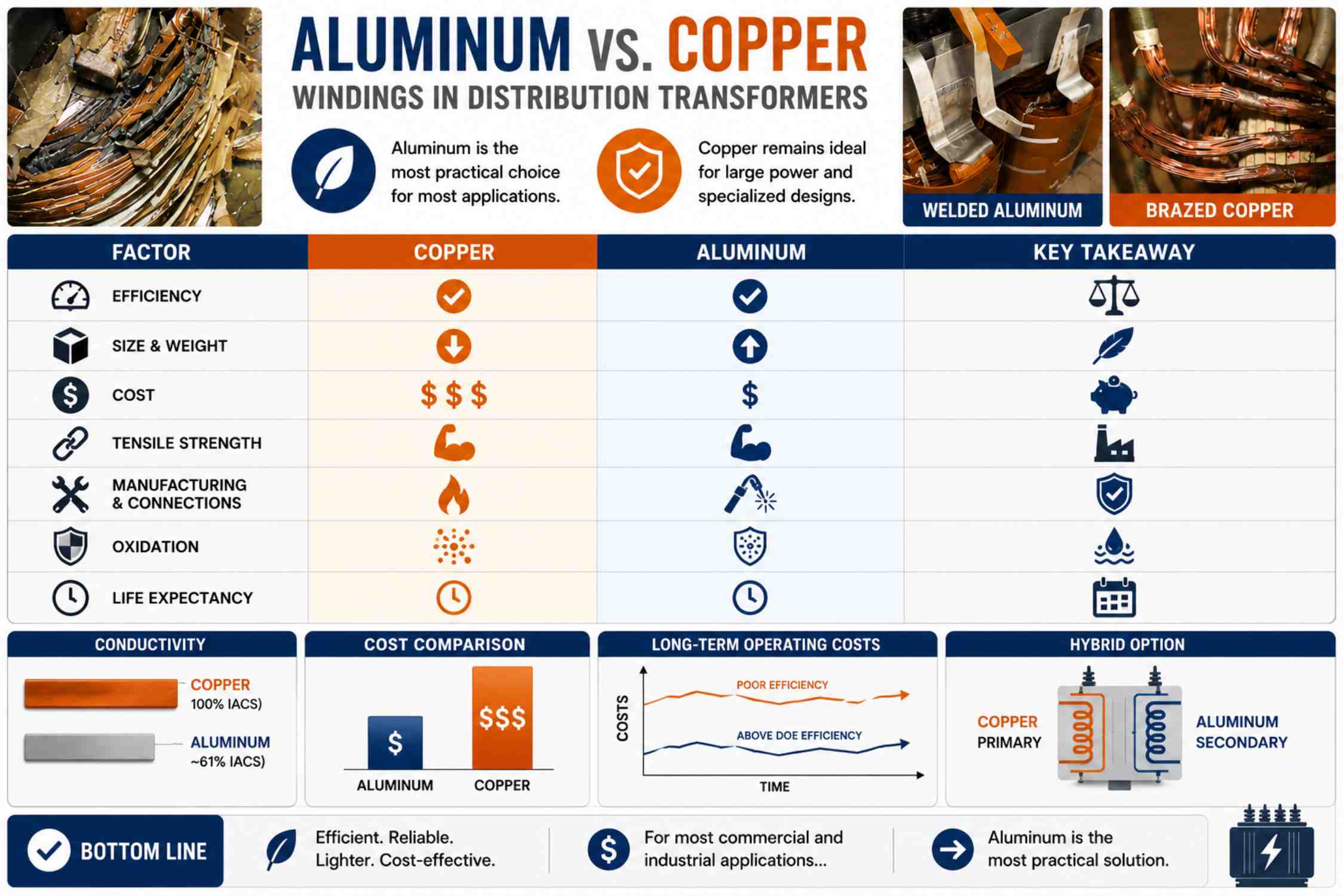
Copper vs. Aluminum Windings at a Glance
| Factor | Copper | Aluminum |
|---|---|---|
| Efficiency | Slightly higher conductivity | Lower conductivity, compensated with larger conductors |
| Size & Weight | Smaller coils, heavier overall | Larger coils, lighter overall |
| Cost | Higher and more volatile | Lower and more predictable |
| Tensile Strength | Higher mechanical strength | Lower tensile strength |
| Connections | Typically brazed | Typically welded |
| Oxidation | Oxidizes without protective layer | Forms protective oxide coating |
| Lifespan | No proven advantage in distribution applications | Comparable lifespan |
Note: DOE efficiency standards require both copper and aluminum distribution transformers to meet the same minimum efficiency levels.
Efficiency
Efficiency is often the first consideration when choosing transformer winding material. The good news is that modern distribution transformers—whether copper or aluminum—must meet the same DOE efficiency standards. For example, a 500 kVA three-phase liquid-filled padmount transformer is legally required to achieve a 99.35% efficiency rating regardless of winding material. Copper has higher electrical conductivity than aluminum. In fact, aluminum conducts electricity at roughly 60% the rate of copper. To compensate, manufacturers increase the cross-sectional area of aluminum conductors, allowing aluminum transformers to achieve comparable energy losses and operating efficiency. Copper still has an advantage when designing transformers that exceed DOE standards or meet extremely low-loss specifications. However, under current DOE 2016 efficiency regulations, transformers below 2,500 kVA typically perform very similarly whether they use copper or aluminum windings. For most commercial and industrial applications, efficiency differences are minimal in practice.
Size and Weight
Coil Size
Copper’s higher conductivity allows manufacturers to use smaller conductors, which can slightly reduce winding size. This matters most in retrofit projects where space is limited. If you’re replacing an older transformer in a tight electrical room or vault, a custom copper-wound design may help reduce the transformer footprint enough to avoid costly infrastructure changes. That said, this is usually a custom-engineered solution rather than a standard offering.
Tank Size
Even though copper windings can reduce coil dimensions, many manufacturers use the same enclosure size for both copper and aluminum models. Ordering copper windings alone does not automatically guarantee a smaller transformer. If footprint reduction is critical, it’s important to discuss custom enclosure options with your transformer supplier.
Weight Considerations
Weight is where aluminum has a major advantage. Copper is significantly denser than aluminum, making copper-wound transformers roughly 20% heavier in many cases. That additional weight can become a major factor for rooftop installations, elevated platforms, or locations with structural limitations. If minimizing weight is important, aluminum is often the better choice.
Cost
Cost is one of the biggest reasons aluminum dominates the distribution transformer market today. Copper is substantially more expensive than aluminum, and its market pricing tends to fluctuate more dramatically. As a result, copper-wound transformers can cost two to three times as much as comparable aluminum units. For large projects involving multiple transformers, the upfront cost difference adds up quickly. Copper can enable lower operating losses in ultra-high-efficiency designs, potentially reducing long-term energy costs. However, in most standard DOE-compliant applications, the operational savings are usually insufficient to offset the significantly higher purchase price over many years.
For most commercial and industrial buyers, aluminum offers the best balance between performance and affordability.
Tensile Strength
Tensile strength refers to a material’s ability to resist mechanical stress and deformation.
- Copper has a significantly higher tensile strength than aluminum, making it ideal for large power transformers subjected to high inrush currents and short-circuit forces. Large substation and power transformers, windings experience intense electromagnetic forces during faults or switching events. Copper’s mechanical strength helps withstand these stresses without deformation. These larger transformers often use circular disc-wound coil designs specifically intended to reinforce the windings against short-circuit forces.
- Aluminum, however, performs extremely well in most distribution-class transformers because they typically use rectangular sheet-wound coil designs. These designs distribute mechanical stress across the winding surface, reducing the importance of conductor tensile strength.
In commercial and industrial transformers below roughly 5 MVA, aluminum and copper are generally on equal footing in terms of mechanical performance.
Manufacturing and Connections
Aluminum offers several manufacturing advantages. Because aluminum is softer and more malleable, it is often easier to form and handle during production. It also bonds well with thermoset insulation systems commonly used in transformer manufacturing.
- Copper requires higher joining temperatures, so copper connections are frequently brazed rather than welded. Brazed joints can introduce slight conductivity losses at connection points.
- Aluminum connections, on the other hand, are commonly welded. Welded aluminum joints create strong, consistent electrical connections with minimal conductivity loss.
Both materials perform reliably when manufactured correctly.
Oxidation
Oxidation is one of the most misunderstood topics in the copper-versus-aluminum debate. Both metals oxidize, but they behave differently. Copper oxidation can continue progressing over time, while aluminum forms a thin oxide layer that actually protects the underlying metal from further corrosion. Some people associate aluminum with connection failures because aluminum building wire has historically caused issues in certain electrical installations. However, that concern generally does not apply to transformer windings. In liquid-filled transformers, winding connections are sealed inside dielectric fluid, preventing exposure to air and moisture. As a result, oxidation-related connection problems are not typically an issue inside properly manufactured transformers.
Life Expectancy
Transformer lifespan depends far more on insulation health and operating conditions than on winding material. At this point, there is no conclusive evidence showing that copper-wound distribution transformers last longer than aluminum-wound units in comparable commercial or industrial environments.
Factors such as:
- Heat management
- Moisture control
- Load conditions
- Maintenance practices
- Insulation quality
have a much greater impact on service life than whether the windings are copper or aluminum.
Can You Combine Copper and Aluminum Windings?
Yes. Some transformers are designed with a copper primary winding and an aluminum secondary winding. This hybrid approach allows manufacturers to place copper where electrical and mechanical stresses are highest—typically on the primary side exposed to inrush current—while still reducing overall material costs through aluminum secondary windings. Although this configuration is less common, it can be a practical compromise for certain specialized applications.
Final Thoughts
Choosing between copper and aluminum windings ultimately comes down to application priorities—not simply performance. Copper still makes sense in some situations, particularly in large power transformers or highly specialized low-loss designs. But modern aluminum-wound distribution transformers are highly efficient, dependable, lighter in weight, and far more cost-effective. For most commercial and industrial applications, aluminum is not a downgrade—it’s simply the most practical solution.