Hipotential Test Set (AC/DC/VLF)
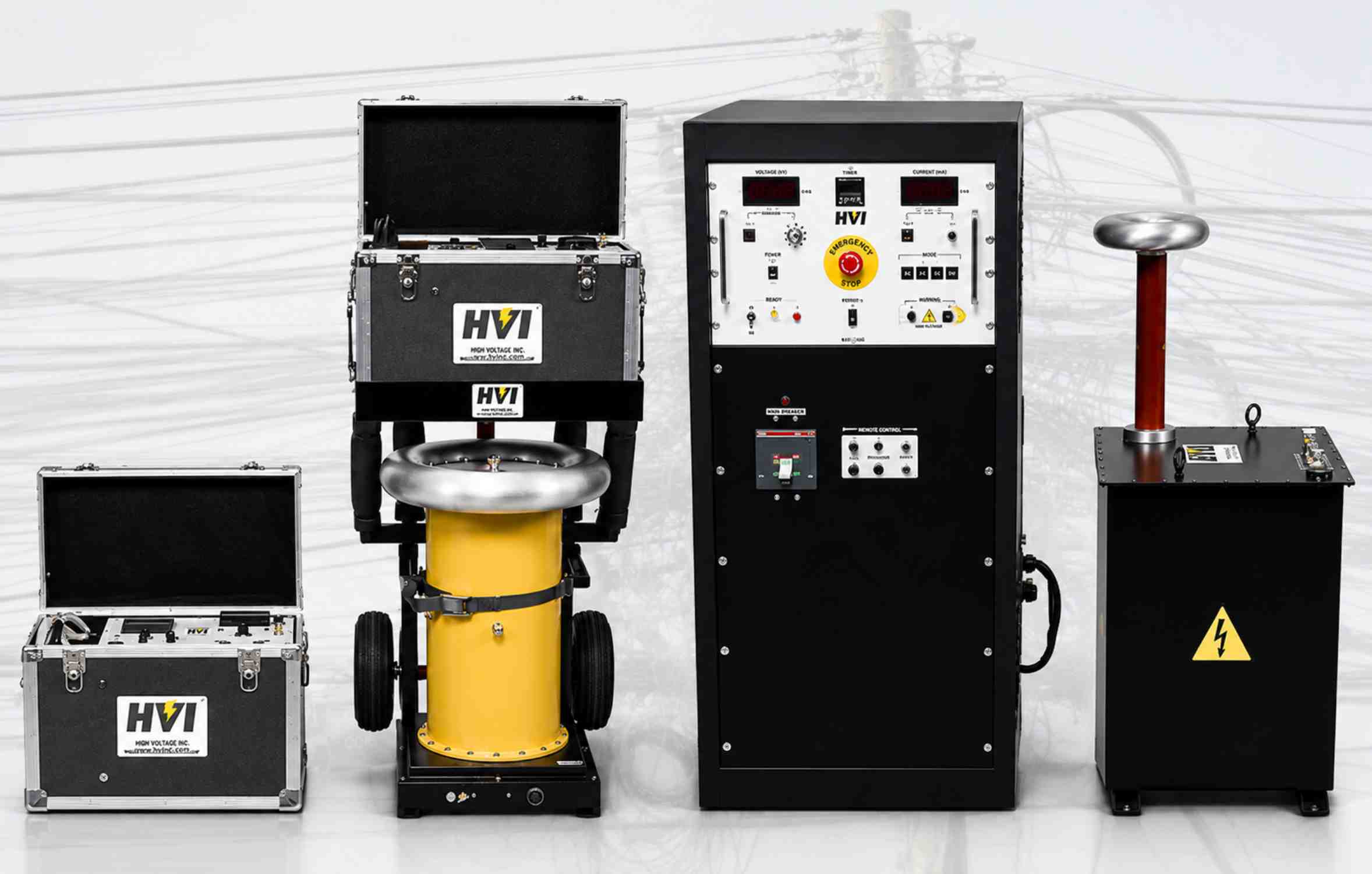
Hipot (high-potential) test sets are used to perform dielectric withstand testing on medium- and high-voltage electrical equipment. The purpose of this test is to verify the integrity of insulation systems by applying a voltage significantly higher than the equipment’s normal operating voltage while monitoring leakage current to ground.
Unlike a continuity test, which confirms the presence of an electrical path, hipot testing evaluates whether insulation can effectively prevent unintended current flow under elevated voltage stress. This makes it a critical safety and reliability assessment for electrical assets such as cables, transformers, switchgear, and rotating equipment.
A standard hipot test setup typically includes three connections: a high-voltage lead, a return lead, and a ground lead. The high-voltage lead is connected to the equipment under test, while non-energized components are grounded. Any leakage current passing through the insulation is measured through the return lead.
If the measured leakage current exceeds the predefined acceptance threshold, the test set’s internal protection circuitry automatically trips, indicating insulation failure. For this reason, hipot testing is commonly considered a “go/no-go” test: the insulation either withstands the applied voltage without triggering the protection system or it fails the test. Rather than requiring a minimum leakage current, the test is based solely on maintaining leakage below the maximum allowable limit.
Hipot test sets are available with output voltages ranging from approximately 1 kV to more than 100 kV and may operate using either AC or DC voltage, depending on the application requirements. AC hipot testing is commonly performed at standard line frequency, while DC testing is often preferred for highly capacitive loads.
Very low frequency (VLF) hipot testing uses a sinusoidal AC waveform at frequencies typically between 0.01 Hz and 0.1 Hz. This method is particularly effective for testing highly capacitive equipment, such as power cables, because it reduces the power demand required to energize the insulation while still providing a reliable assessment of dielectric condition.