The Unified Power Flow Controller (UPFC): Operational Principles, Control Paradigms, and Dynamic Characteristics
Abstract
The Unified Power Flow Controller (UPFC), conceptualized by Gyugyi, represents the most functionally comprehensive device within the Flexible AC Transmission Systems (FACTS) portfolio. It is designed to simultaneously and independently regulate transmission line parameters, specifically voltage magnitude and active/reactive power flow. This paper delineates its architecture, dual-converter control methodology, protection schemes, and salient characteristics, including its influence on subsynchronous resonance (SSR).
1. Introduction & Topology
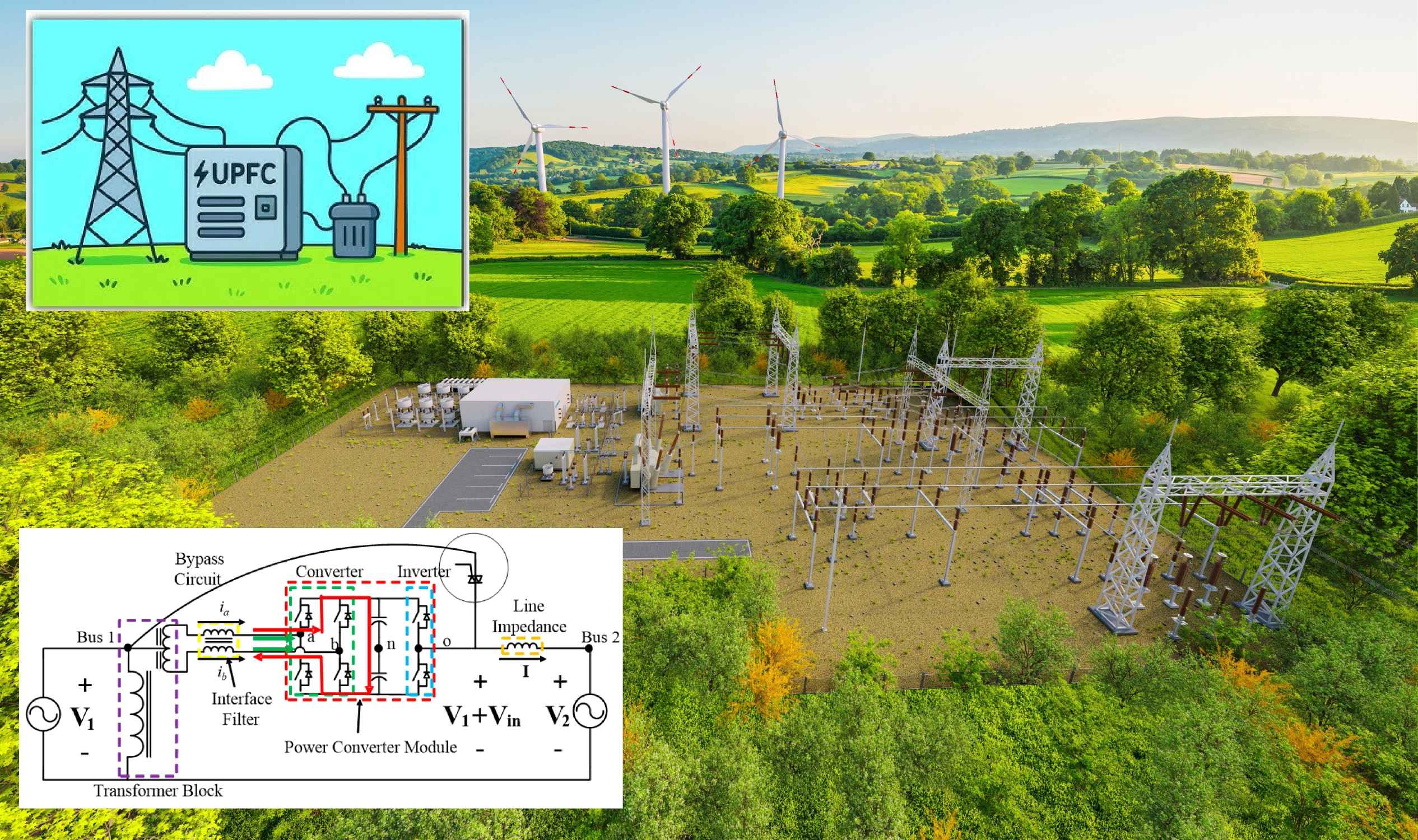
The UPFC integrates two voltage-sourced converters (VSCs)—one configured in shunt and the other in series with the transmission line—interconnected via a standard DC-link capacitor. This configuration enables bidirectional real power exchange between the converters. In a decoupled state (with the DC-link switches open), the converters operate independently as a Static Synchronous Compensator (STATCOM) and a Static Synchronous Series Compensator (SSSC), providing reactive compensation. Closing the DC-link switches unifies the system, allowing the series converter to inject a controllable voltage phasor with specified magnitude and phase, thereby enabling combined control of real and reactive power flow. This grants the UPFC three independent degrees of freedom for control.
2. Control System Architecture
Control is implemented separately for each converter and coordinated via the DC-link power balance.
- 2.1 Shunt Converter Control: The shunt converter controls the current drawn from the AC bus. Its primary objectives are: (1) to regulate the DC-link capacitor voltage via the active current component (I_p), thereby maintaining real power balance with the series converter, and (2) to control the reactive current component (I_r). It typically operates in one of two modes:
- VAR Control Mode: The reactive current reference is directly set by an external VAR command.
- Automatic Voltage Control Mode: The reactive current reference is generated by a voltage feedback controller with a defined droop characteristic to regulate the AC bus voltage (V_1).
- 2.2 Series Converter Control: The series converter controls the injected series voltage phasor (V_C). Key operational modes include:
- Direct Voltage Injection Mode: The converter generates a specified voltage phasor, with quadrature voltage injection as a special case for pure reactive compensation.
- Phase Angle Shifter Emulation Mode: The injected voltage is phase-shifted relative to the sending-end voltage (V_1) by a commanded angle.
- 2.3 Operating Constraints: Steady-state operation is bounded by six principal limits: shunt converter current magnitude, shunt converter voltage output, series converter voltage magnitude, line current through the series transformer, permissible line-side voltage range, and the DC-link power transfer capability.
3. Protection Schemes
The semiconductor-based converters require robust protection against fault currents. For the series converter, a fast-acting thyristor bypass switch diverts excessive line current within microseconds. For sustained faults, a mechanical bypass breaker is closed across the series transformer’s primary winding. Re-insertion requires a synchronized startup procedure to match the converter current with the line current before opening the bypass. The shunt converter is protected primarily by interrupting the gating signals during overcurrent transients, with breaker tripping reserved for severe internal failures.
4. Subsynchronous Resonance (SSR) Characteristics
A significant advantage of the UPFC is its inherent capability to mitigate SSR. By controlling the fundamental component of the injected series voltage (V_p) to emulate a positive resistance, the UPFC can provide effective damping to critical torsional modes. Analytical studies, such as those based on the IEEE First Benchmark Model, demonstrate that while a purely reactive series injection may leave a torsional mode undamped, the addition of a positive resistance component ensures adequate damping, potentially eliminating the need for a dedicated Subsynchronous Damping Controller (SSDC).
5. Applications & System Impact
The UPFC is indicated in complex grid scenarios that require concurrent management of the voltage profile and multi-directional power flow. Its multiple control degrees of freedom provide unparalleled flexibility in restructured power systems, allowing the independent regulation of bus voltage and both active and reactive line power flows. System planning studies are essential for determining optimal placement and rating.
6. Conclusion
The UPFC stands as a pinnacle of FACTS technology, offering integrated solutions for voltage support, power flow control, and system stability enhancement, including inherent SSR mitigation. Its dual-converter, shared DC-link architecture facilitates unique control capabilities that address multiple grid challenges simultaneously, making it a critical asset for modern, efficient, and stable power transmission.