A Comparative Analysis of Safety Limit Calculations for Earthing Systems: IEEE Std. 80 versus IEC 60479
Abstract
This paper conducts a systematic review and comparative analysis of the methodologies prescribed by IEEE Std. 80-2013 and IEC 60479-1:2010 for establishing permissible touch and step voltage limits in electrical power installations. The fundamental equations and underlying physiological assumptions of each standard are examined. A quantitative comparison of the resulting safety criteria is presented, highlighting significant divergences arising from differing models of human body impedance, ventricular fibrillation thresholds, and the treatment of external resistances.
I. Introduction
The design of a safe earthing system serves two primary functions: to provide a reliable path for fault and operational currents without exceeding equipment ratings, and to mitigate the risk of electric shock to personnel in the vicinity of earthed installations. During an earth fault, current flow produces potential gradients on the earth’s surface. A critical design objective is to ensure that the maximum prospective touch and step voltages during a fault remain below established safety limits, which are derived from international standards based on the electrophysiological effects of electric current on the human body.
This article delineates the mathematical formulations for safe touch and step voltage limits at power frequency (50/60 Hz) as per contemporary international standards, principally IEEE Std. 80 and IEC 60479, and provides a comparative evaluation of their results. It is noted that existing standards do not prescribe limits for high-frequency transients such as lightning currents; proposed interim limits for specific impulse waveforms are referenced.
II. Governing Safety Standards
The establishment of safety criteria is founded upon extensive empirical research into the effects of electric current magnitude, duration, and frequency on the human body. The two preeminent international standards codifying this research are IEEE Std 80-2013 and IEC 60479-1:2010. Related standards, including BS 50522:2010 and EN 50522:2010, are derived from the IEC framework.
III. Methodological Frameworks
A. IEEE Std. 80-2013
- Tolerable Body Current: The standard, based on Dalziel’s work [5], defines the fibrillation current threshold as a function of body weight. Formulas are provided for 50 kg and 70 kg body masses, representing the current survival rates of 99.5% and 99.4% of the population, respectively.
- Body Impedance Model: A fixed internal body resistance of 1000 Ω is assumed, exclusive of foot contact resistance. The foot is modeled as a conductive circular plate with a radius of 0.08 m.
- Foot Resistance ((R_f)): Calculated considering the surface layer resistivity ((ρ_s)) and a corrective scaling factor ((C_s)) for high-resistivity surface materials (e.g., crushed rock). The (C_s) factor accounts for the additional series resistance introduced by such a layer.
- Safety Voltage Equations: The permissible touch voltage (E_touch) and step voltage (E_step) are subsequently derived by combining the tolerable body current, body resistance, and foot resistance. The standard does not permit the inclusion of additional resistances from footwear or gloves.
B. IEC 60479-1:2010
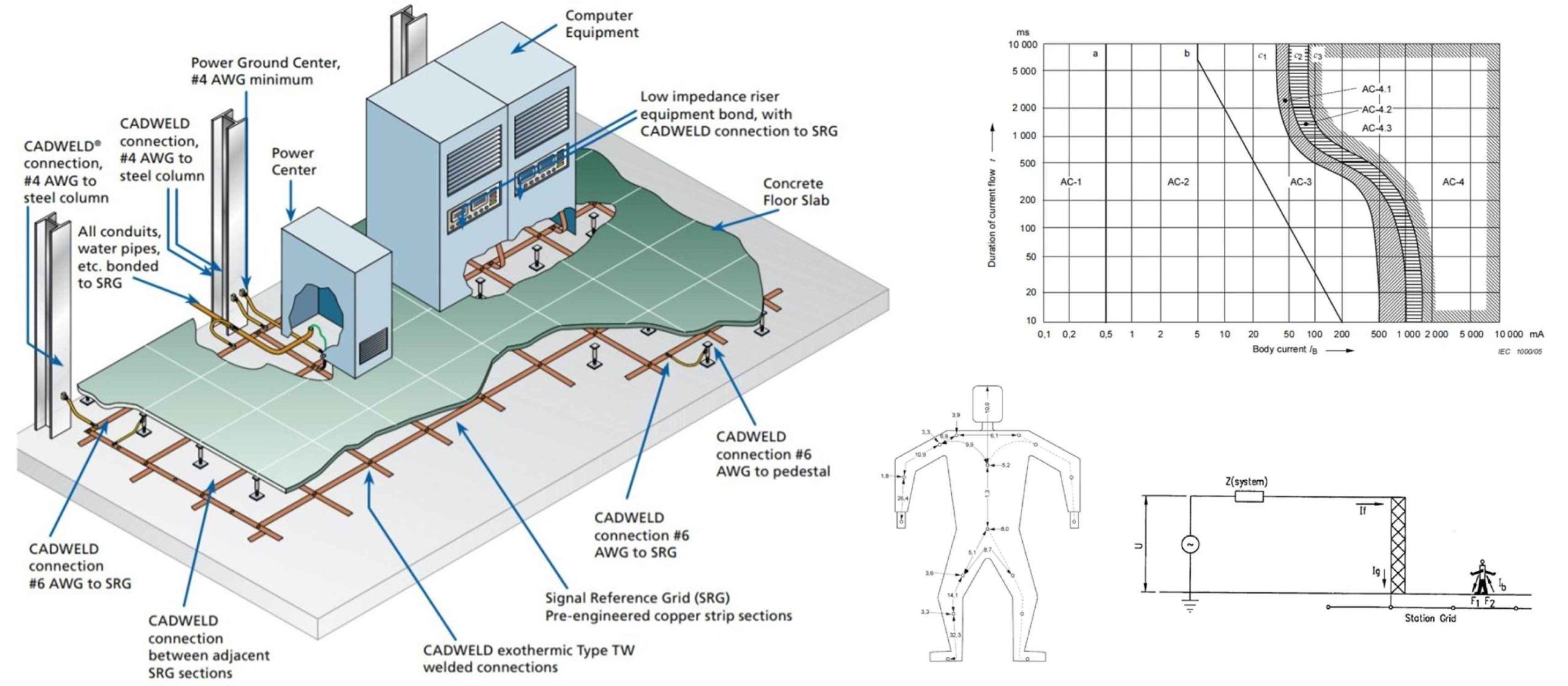
- Tolerable Body Current: Ventricular fibrillation thresholds are presented as time-dependent curves. A notable reduction in permissible current occurs near 400 ms, attributed to the cardiac cycle’s vulnerable T-wave period.
- Body Impedance Model: Impedance is treated as a variable dependent on touch voltage and contact conditions (wet/dry), with percentile values (5th, 50th, 95th) provided for population statistics. Hand-to-foot impedance is acknowledged as being 10-30% lower than hand-to-hand.
- Body Current Path Factors: The standard introduces a heart-current factor (F) and a body factor to adjust thresholds for current paths other than the left hand-to-feet.
- Derivation of Safety Voltages: Unlike IEEE Std. 80, IEC 60479 does not provide direct formulas for permissible touch/step voltages. The procedure involves:
- Determining permissible body current from duration/probability curves
- Obtaining the corresponding body impedance
- Calculating foot resistance (typically per IEEE)
- Computing the allowable voltages.
C. Derived Standards: EN 50522 & BS 50522
These European and British standards are largely aligned with IEC 60479 but specify distinct parameter selections:
- EN 50522:2010: Utilizes the 50th percentile body impedance and the c2 fibrillation probability curve.
- BS 50522:2010: Employs the more conservative 5th percentile body impedance with the c2 fibrillation curve.
IV. Comparative Analysis and Results
A simulation was performed to compare the allowable touch and step voltages for each standard under common conditions: absence of a surface layer, no additional resistances, and foot resistance calculated per IEEE Std. 80.
- IEC 60479-1 Results: Allowable voltages were calculated for fibrillation probability curves c1, c2, and c3, using 50th percentile body impedance. The results demonstrate a pronounced time-dependency, particularly around the 400 ms threshold.
- IEEE Std. 80 Results: Allowable voltages were calculated for 50 kg and 70 kg body weights. The curves exhibit a less pronounced inflection than the IEC results, consistent with the (1/\sqrt{t}) relationship inherent in its formulation.
V. Discussion and Conclusion
The analysis reveals fundamental philosophical and methodological differences between the standards. IEEE Std. 80 offers a more direct, prescriptive calculation method centered on body weight and a fixed body impedance. In contrast, IEC 60479 presents a more granular, physiologically detailed model incorporating variable body impedance, heart-cycle timing, and multiple current paths.
Key findings include:
- The IEC 60479 methodology is inherently more complex and less prescriptive than that of IEEE Std. 80.
- IEEE Std. 80s use of a fixed 1000 Ω body impedance represents a simplification that may not encompass population variability.
- IEC 60479 explicitly models the critical reduction in safe current around 400 ms due to cardiac cycle effects, a feature absent from the IEEE model.
- For fault durations shorter than approximately 400 ms, the IEC standard typically yields higher permissible voltage limits than IEEE Std. 80.
Appendix: Note on Decrement Factor
The decrement factor accounts for the asymmetrical (DC offset) component of fault current. IEEE Std. 80 defines an effective asymmetrical fault current by applying this factor to the symmetrical RMS current. Consistent with established best practice and the rationale in [9], it is recommended that the decrement factor be applied to the fault current parameter itself, thereby appropriately increasing the calculated earth potential rise and related step/touch voltages, rather than reducing the allowable safety voltage limits.