Substations are designed differently based on voltage, space, and environment
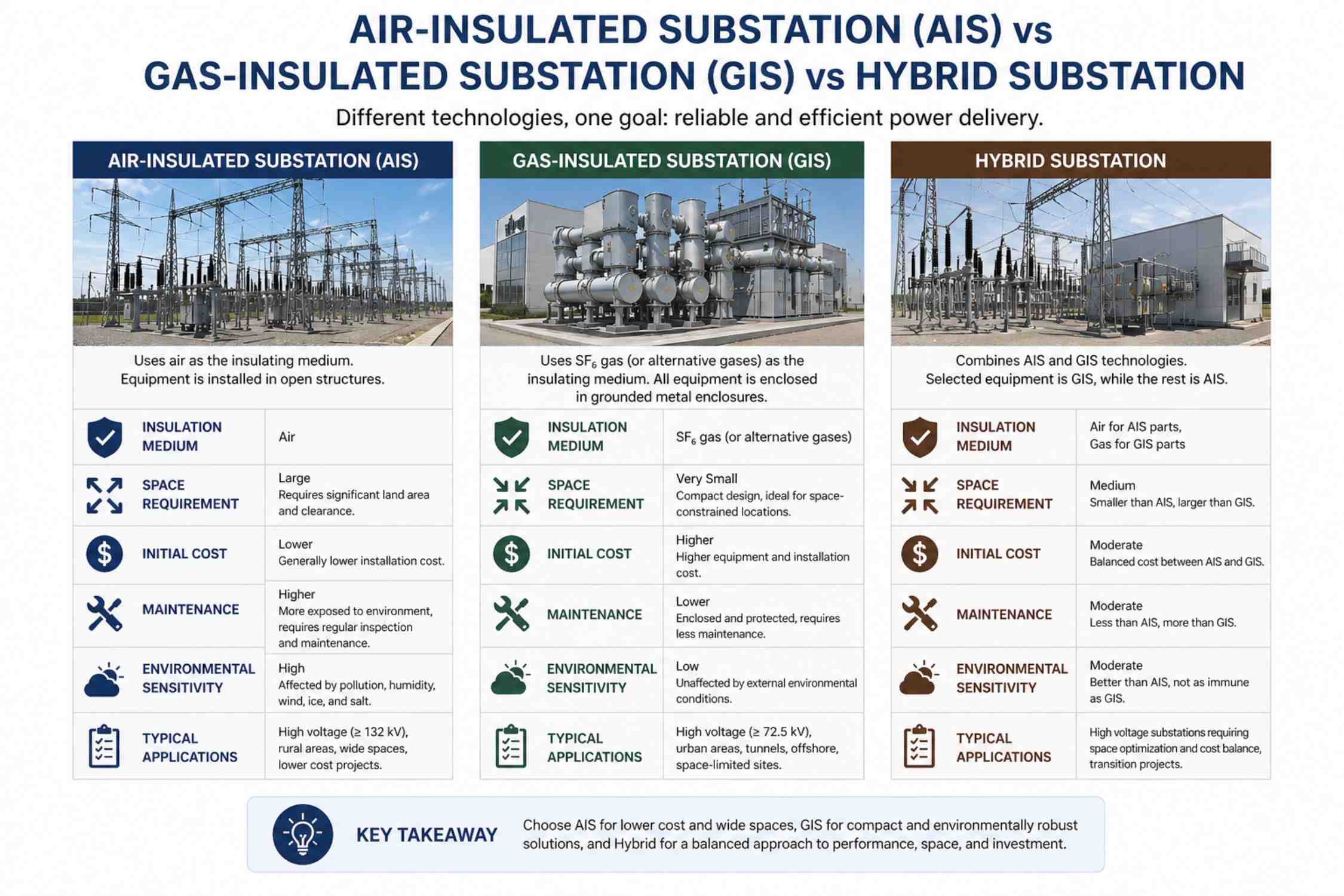
Air-Insulated Substation (AIS):
Description: All live components (busbars, breakers, isolators) are separated by air gaps and mounted on steel structures. Pros: Lower cost, easier maintenance, visible components.Cons: Requires a large land area, exposed to weather and pollution. Typical Use: Most outdoor transmission and distribution substations.
Gas-Insulated Substation (GIS):
All major live components are housed in sealed metal compartments filled with Sulfur Hexafluoride (SF₆), an excellent insulator. Pros: Extremely compact (can be 10% the size of an AIS), immune to weather and pollution, high reliability.Cons: Significantly higher cost, specialized maintenance required. Typical Use: Urban areas where land is scarce, inside buildings, or in harsh environments.
Hybrid Substation:
Combines AIS and GIS sections (e.g., GIS for the high-voltage bus, AIS for the transformers).
Summary: The Key Point Between Production and Consumption
Imagine the power grid as the human circulatory system:
- Power Plants are the heart.
- High-Voltage Transmission Lines are the arteries.
- Substations are the pressure-regulating valves and distribution hubs (like major arteries branching into capillaries).
- Distribution Lines and Consumers are the capillaries and cells.
The substation’s ultimate role is to ensure that electrical energy is delivered efficiently (via transformation), safely (via protection), and reliably (via control and switching) from the point of generation to every point of use. It is the indispensable and intelligent node that makes a modern, interconnected power grid possible.