Understanding Electrical Wires & Their Applications
When setting up an electrical system—whether for a cozy home, a bustling office, or a heavy-duty factory—the wires and cables you choose are the unsung heroes. They are the circulatory system of your infrastructure, carrying lifeblood (electricity) to every corner.
Choosing the right wire size and type isn’t just about getting the lights to turn on; it is critical for safety, efficiency, and long-term reliability. Using the wrong cable can lead to voltage drops, overheating, energy losses, or even catastrophic fires.
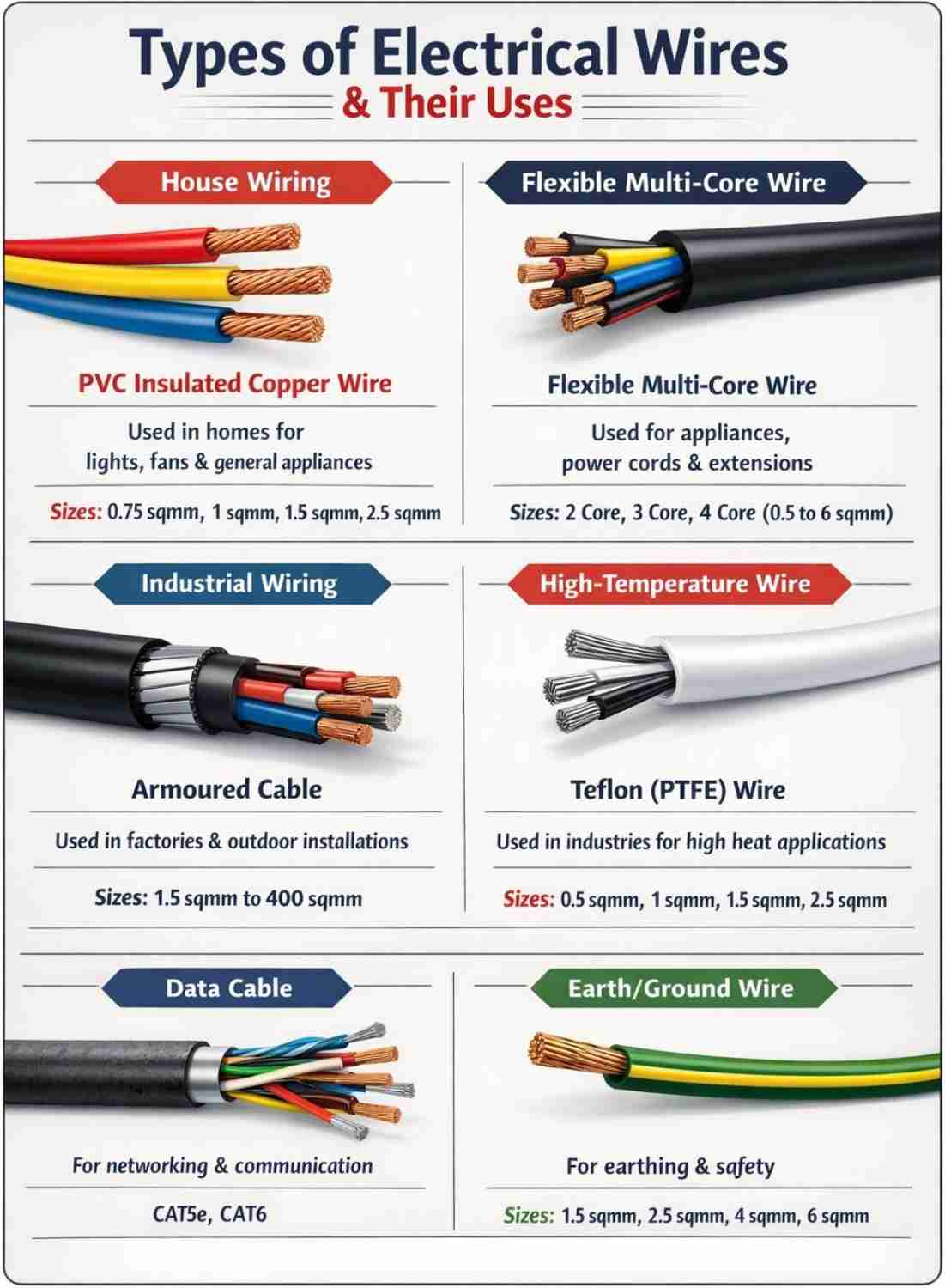
To simplify this complex topic, I’ve broken down the most common types of electrical wires and their specific applications based on a recent visual guide. Whether you are a homeowner, a contractor, or an industry professional, understanding these distinctions is the foundation of a reliable electrical system.
1. House Wiring: The Backbone of Your Home
For standard residential applications, PVC Insulated Copper Wire is the industry standard. Copper is preferred for its excellent conductivity and durability, while the PVC (Polyvinyl Chloride) insulation provides a robust layer of protection against abrasion and moisture.
- Common Uses: Lighting circuits, ceiling fans, and general-purpose power sockets.
- Sizes: These typically range from 0.75 sq mm to 2.5 sq mm.
- 0.75 – 1 sqmm: Generally used for lighting circuits.
- 1.5 – 2.5 sqmm: Used for power sockets and heavy-duty appliances like geysers or air conditioners in a home setting.
2. Flexible Multi-Core Wire: Versatility in Motion
Unlike single-core house wires, Flexible Multi-Core Wires are designed to handle movement and bending. They consist of multiple thin strands of copper, making them pliable and resistant to metal fatigue.
- Common Uses: These are the wires you find inside appliance power cords, extension boards, and portable equipment.
- Configuration & Sizes: Available in 2-Core, 3-Core, and 4 Core configurations (the third core is usually the earth/ground wire). The sizes range from 0.5 to 6 sqmm, depending on the appliance’s load.
3. Industrial Wiring: Built for the Rough Stuff
When you move into industrial environments—factories, outdoor plants, or underground installations—the wiring needs to survive extreme conditions. This is where Armoured Cable comes into play.
These cables are equipped with a layer of armor (usually steel wire or tape) between the inner sheath and the outer cover. This armor protects the cable from mechanical damage, rodents, and harsh weather.
- Common Uses: Heavy machinery, main power feeders in factories, outdoor power distribution, and underground supply lines.
- Sizes: The sheer scale of industrial power requires a massive range, from 1.5 sqmm for control circuits up to 400 sqmm for high-current main feeders.
4. High-Temperature Wire: Withstanding the Heat
Standard PVC insulation can melt or degrade under high heat. In environments where heat is a byproduct—such as near furnaces, in lighting fixtures, or within industrial ovens—Teflon (PTFE) Wire is essential.
PTFE insulation offers exceptional thermal stability, chemical resistance, and dielectric strength. It ensures that the wire continues to perform safely even when the mercury rises.
- Common Uses: High-heat industrial applications, automotive engines, and LED lighting.
- Sizes: Commonly available in 0.5 sqmm, 1 sqmm, 1.5 sqmm, and 2.5 sqmm.
5. Data Cables: The Nervous System
In the modern era, an electrical system isn’t just about power; it is also about communication. Data Cables ensure that our networks remain stable and fast.
- Common Uses: Networking, internet connectivity, telephone systems, and security cameras.
- Types: The current standards for reliable communication are CAT5e and CAT6. CAT6 is generally preferred for higher bandwidth and faster data transfer rates over longer distances.
6. Earth/Ground Wire: The Silent Guardian
Safety is non-negotiable in electrical engineering. The Earth/Ground Wire provides a path of least resistance for fault current, directing it safely into the ground. This prevents electric shock and protects equipment from damage during short circuits or lightning strikes.
- Common Uses: Critical for every circuit to ensure electrical safety and protection.
- Sizes: Typically sized according to the circuit’s capacity, ranging from 1.5 sqmm, 2.5 sqmm, 4 sqmm, to 6 sqmm.
Conclusion: Why Correct Selection Matters
As an Electrical Maintenance Engineer, I see the consequences of incorrect cable selection daily. A wire that is too small for the load acts like a bottleneck, generating excessive heat that degrades insulation and wastes energy. Conversely, using the wrong type of insulation (like PVC in a high-heat area) leads to premature failure.
⚡ Correct cable selection = Reduced losses + Improved safety + Longer equipment life
Before starting any electrical project—big or small—take the time to calculate your load requirements and assess your environmental conditions. Investing in the right wire type and size upfront is the cheapest insurance policy you can buy for the safety and longevity of your electrical infrastructure.