Understanding the Characteristics of a Transformer in an SLD
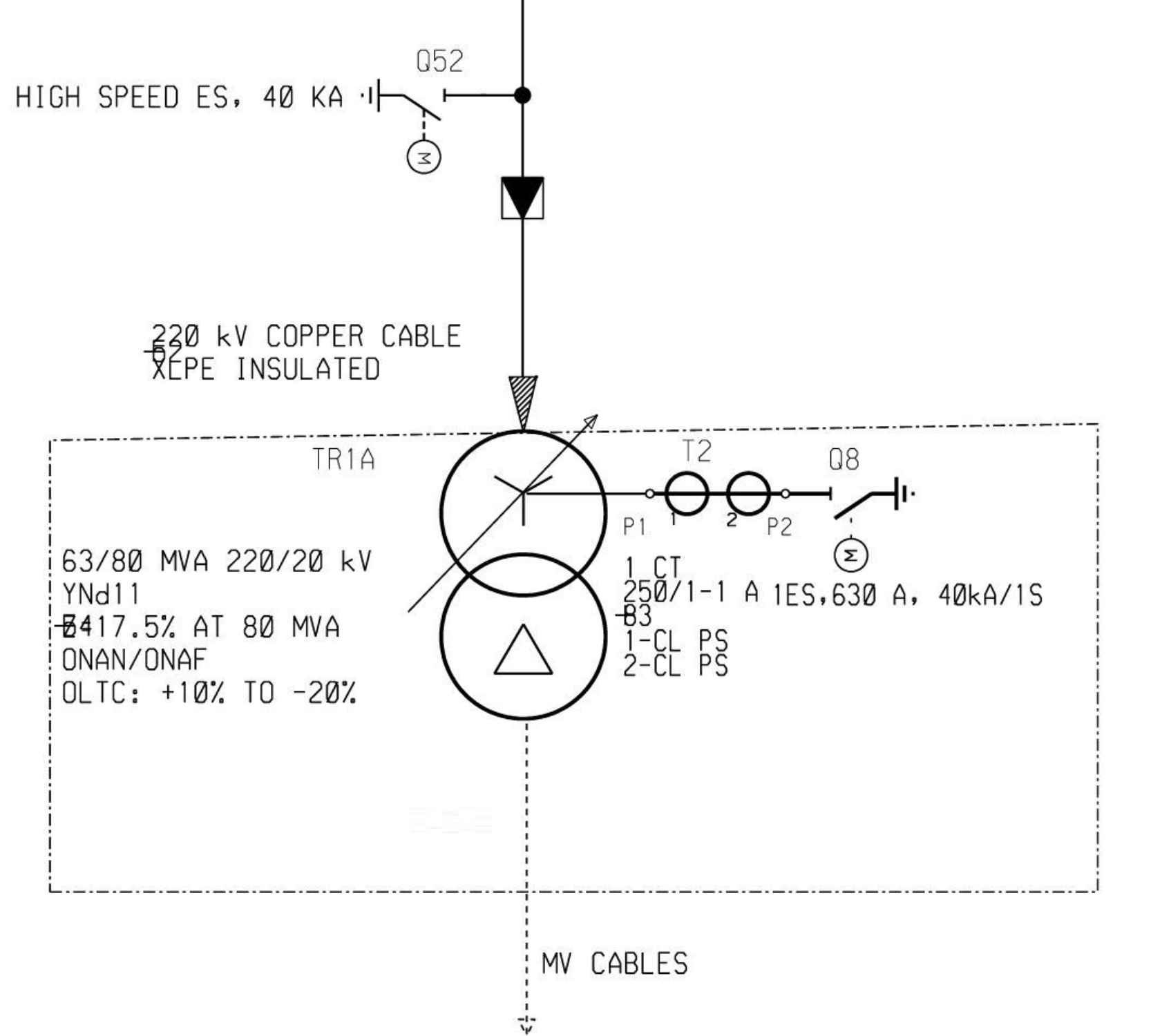
In a Single Line Diagram (SLD), a transformer is represented by a compact symbol and a short list of technical data. While it may look simple, every line of information tells a detailed story about the transformer’s design, operating limits, and role in the power system. Let’s break down these characteristics using a typical 220/20 kV power transformer as an example.
1. Transformer Rating: 63 / 80 MVA
The transformer has two MVA ratings, depending on the operating cooling method.
🔹 63 MVA – ONAN Rating
This is the continuous rating under ONAN (Oil Natural, Air Natural) cooling.
- Heat is removed by natural circulation of oil inside the transformer.
- Heat is dissipated to the surroundings through natural airflow.
- No fans or pumps are running.
- The transformer can safely deliver 63 MVA continuously without exceeding thermal limits.
This rating represents the most reliable and maintenance-free operating condition.
🔹 80 MVA – ONAF Rating (Maximum Rating)
This is the enhanced rating under ONAF (Oil Natural, Air Forced) cooling.
- When the transformer load increases, the oil temperature rises.
- Cooling fans automatically start, forcing air over the radiators.
- Improved heat dissipation allows higher loading.
With ONAF cooling, the transformer can deliver up to 80 MVA, typically during peak load conditions. 63 MVA without fans, 80 MVA with fans.
2. Voltage Rating: 220 / 20 kV
This defines the transformer’s primary and secondary voltages.
- 220 kV: High Voltage (HV) side
- 20 kV: Low Voltage (LV) side
The transformer steps down power from the transmission level (220 kV) to the distribution or sub-transmission level (20 kV). This voltage transformation is a key function in power systems, enabling efficient long-distance transmission and safe distribution.
3. Vector Group: YNd11
The vector group describes how the windings are connected and how the voltages on each side are phase-shifted.
🔹 Y – HV Side Connection (Star)
- The primary winding is connected in star (Y).
- Suitable for high voltages due to reduced insulation stress.
🔹 N – Neutral Brought Out
- The star point of the HV winding is accessible.
- Typically grounded to improve system stability and protection during faults.
🔹 d – LV Side Connection (Delta)
- The secondary winding is connected in a delta (Δ).
- Delta connection helps:
- Suppress third-harmonic currents
- Improve system balance under unbalanced loads
🔹 11 – Phase Shift (Clock Notation)
- “11” means the LV side voltage leads the HV side voltage by 30°.
- In clock terms, HV is at 12 o’clock, and LV is at 11 o’clock.
This phase shift is critical when operating transformers in parallel or designing interconnected power systems.
4. Percentage Impedance: Z = 17.5% at 80 MVA
The percentage impedance is the transformer’s internal impedance.
- Used primarily for short-circuit and fault current calculations.
- A 17.5% impedance means:
- The transformer will limit the fault current to approximately
1 / 0.175 ≈ 5.7 times the rated current.
- The transformer will limit the fault current to approximately
- Higher impedance → lower fault current → less mechanical and thermal stress.
This value is specified at the 80 MVA rating, since impedance varies slightly with loading.
5. Cooling System: ONAN / ONAF
This transformer supports dual cooling modes:
- ONAN for normal operation
- ONAF for higher loading conditions
The automatic transition between these modes improves:
- Operational flexibility
- Efficiency
- Transformer life expectancy
6. OLTC – On-Load Tap Changer
The transformer is equipped with an OLTC, which allows:
- Adjustment of the transformer turns ratio
- Voltage regulation while the transformer is energized
- No interruption to the power supply
OLTCs are essential for maintaining a stable output voltage despite:
- Load variations
- Input voltage fluctuations
They are typically installed on the HV side of the transformer.
Conclusion
Every transformer parameter shown on an SLD carries practical engineering significance. From cooling methods and voltage ratings to vector groups and impedance values, these details define how the transformer behaves under normal operation, overloads, and fault conditions. Understanding these characteristics allows engineers to interpret system diagrams accurately, perform reliable protection and fault studies, and ensure safe and efficient power system operation.