Comprehensive Technical Report: Transformer Insulation Dehydration and Low Frequency Heating (LFH) Technologies
1. Introduction: The Critical Role of Insulation in Transformer Longevity
Insulation is the cornerstone of power transformer reliability. While modern transformers are robust, their operational lifespan is fundamentally limited by the health of their solid insulation system, primarily composed of cellulose-based paper and pressboard. Unlike the transformer oil, which can be reclaimed or replaced, the degradation of solid insulation is irreversible. Consequently, the service life of a transformer is effectively the service life of its paper insulation.
2. The Science of Cellulose Degradation
The primary component of transformer paper is cellulose, a long-chain polymer of glucose molecules. The health of this insulation is measured by the Degree of Polymerization (DP), which represents the average number of glucose units in a cellulose chain.
| Parameter | Typical Value | Significance |
| Initial DP | 1,000 – 1,200 | New, high-strength insulation. |
| Intermediate DP | 500 – 800 | Normal aging; insulation remains mechanically sound. |
| End-of-Life DP | 200 – 250 | Critical loss of mechanical strength; high risk of failure under short-circuit stress. |
2.1 The Impact of Moisture
Moisture is the “silent killer” of transformer insulation. It acts as a catalyst for hydrolysis, a chemical reaction that breaks the cellulose chains.
•Acceleration of Aging: A doubling of moisture content can halve the remaining life of the insulation.
•Dielectric Strength: Water reduces the breakdown voltage of both the oil and the paper, increasing the risk of internal arcing.
•Bubble Formation: During sudden load increases, moisture in the paper can turn into steam, forming bubbles that may lead to immediate catastrophic failure.
3. Comparative Analysis of Transformer Drying Technologies
To mitigate the risks associated with moisture, various dehydration methods have been developed. These range from traditional field techniques to advanced factory-grade solutions.
| Method | Mechanism | Advantages | Disadvantages |
| Hot Air Drying | External heating via blowers. | Simple, low cost. | Inefficient; heat does not penetrate deep into the windings. |
| Hot Oil Circulation | Circulating heated oil through the tank. | Can be done on-site; cleans the oil. | Very slow; moisture removal from deep insulation is limited. |
| Vapor Phase Drying (VPD) | Solvent vapor (e.g., kerosene) transfers heat. | Extremely fast and uniform. | Requires a specialized vacuum chamber; mostly for factory use. |
| Thermal Vacuum Drying | Heat combined with high vacuum. | Effective moisture extraction. | Requires the core to be heated externally; slow heat transfer in vacuum. |
| Low Frequency Heating (LFH) | Internal Joule heating via 1Hz current. | Fastest on-site method; uniform internal heating. | Requires specialized power electronics and control systems. |
4. Deep Dive: Low Frequency Heating (LFH) Technology
Low Frequency Heating represents the pinnacle of on-site transformer drying technology. It addresses the fundamental challenge of traditional methods: the difficulty of heating the core and windings uniformly when they are inside a vacuum.
4.1 The Physics of 1Hz Heating
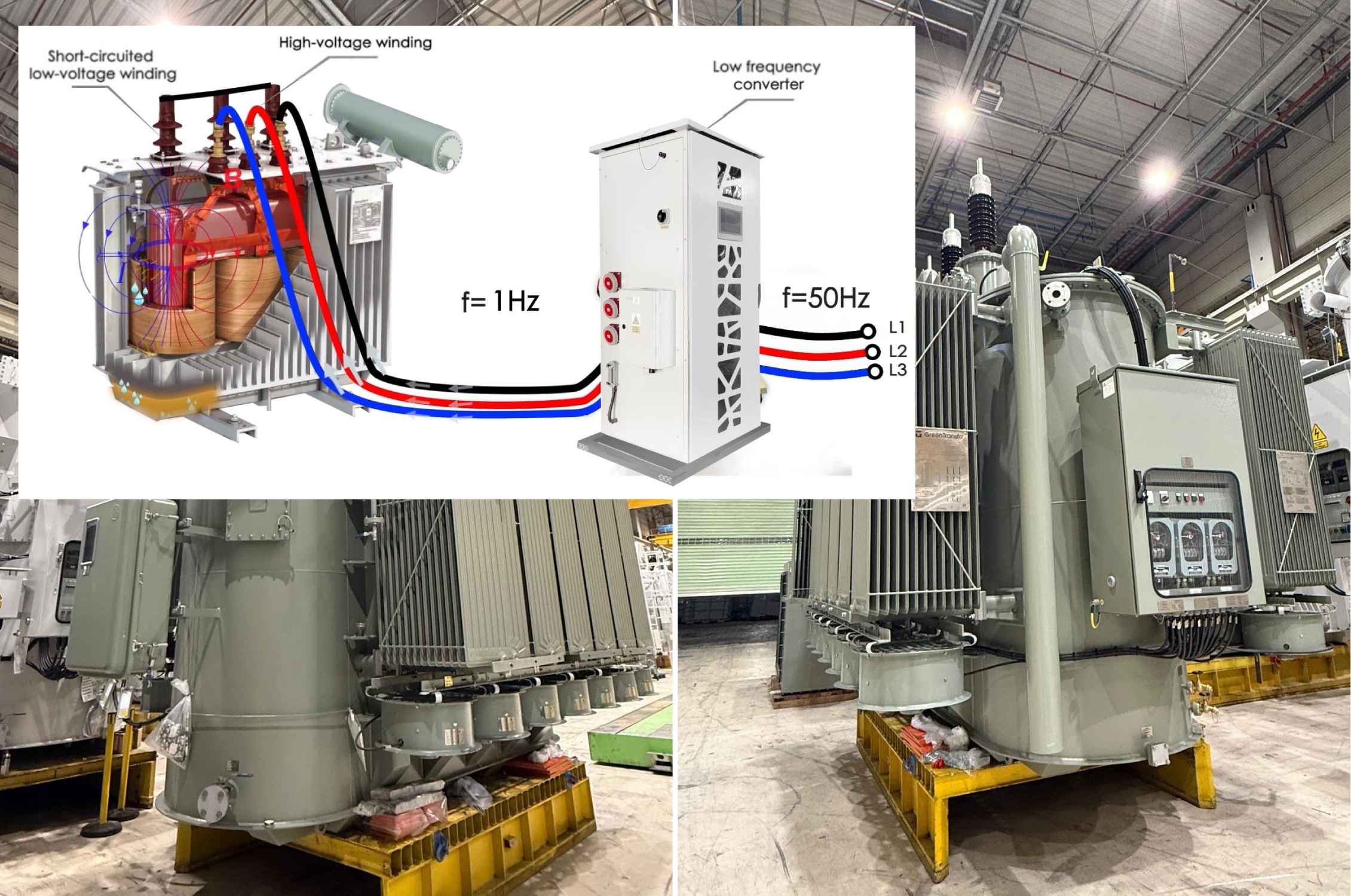
In a standard 50/60Hz system, the high inductance of transformer windings creates significant reactance ($X_L = 2\pi f L$), making it impossible to drive high heating currents at manageable voltages. By reducing the frequency to approximately 1 Hz, the inductive reactance is minimized.
•Internal Heat Generation: Heat is generated directly within the copper conductors (Joule effect: $P = I^2 R$). This ensures that the insulation closest to the heat source—the most critical part—is dried first.
•Optimal Temperature Control: Windings are typically heated to 110°C – 120°C. Advanced LFH systems monitor windings’ resistance in real time to calculate average temperature, preventing localized overheating.
4.2 Implementation Workflow
- Preparation: The transformer oil is drained (for “dry” LFH) or lowered.
- Connection: The high-voltage (HV) windings are connected to the LFH power source, while the low-voltage (LV) windings are short-circuited.
- Heating Phase: A controlled 1Hz current is applied. The magnetic coupling ensures both winding sets are heated simultaneously.
- Vacuum Application: As the insulation heats up, water evaporates. A vacuum pump removes the resulting water vapor.
- Monitoring: Moisture extraction is monitored via the rate of water collection or dielectric response analysis (FDS/PDC).
5. Strategic Applications
5.1 New Transformer Commissioning
During the final stages of manufacturing or after on-site assembly, LFH is used in conjunction with vacuum chambers to ensure the insulation starts its service life at a moisture level below 0.5%.
5.2 Life Extension for Service-Aged Units
For older transformers, LFH can be performed during major maintenance. By removing accumulated moisture, the rate of cellulose degradation is significantly slowed, potentially adding 10–15 years to the unit’s operational life. In these cases, LFH is often combined with Oil Reclamation, where the oil is degassed and filtered while the windings are being dried.
6. Conclusion
The management of moisture in transformer insulation is not merely a maintenance task but a strategic necessity for grid reliability. While traditional drying methods remain useful for smaller units, Low Frequency Heating (LFH) provides a superior, scientifically grounded approach for large power transformers. By generating heat within the windings, LFH ensures a faster, more thorough, and safer dehydration process, directly contributing to the extended, efficient service life of the global power infrastructure.
References
- IEEE C57.140: Guide for Evaluation and Reconditioning of Liquid Immersed Power Transformers.
- CIGRE Brochure 349: Moisture Knowledge, Measurement, and Interpretation in Transformer Insulation.
- Technical Documentation: GlobeCore, Hitachi Energy, and ABB Transformer Service Divisions.