Power Transformer & Feeder Protection – Practical Settings Insight
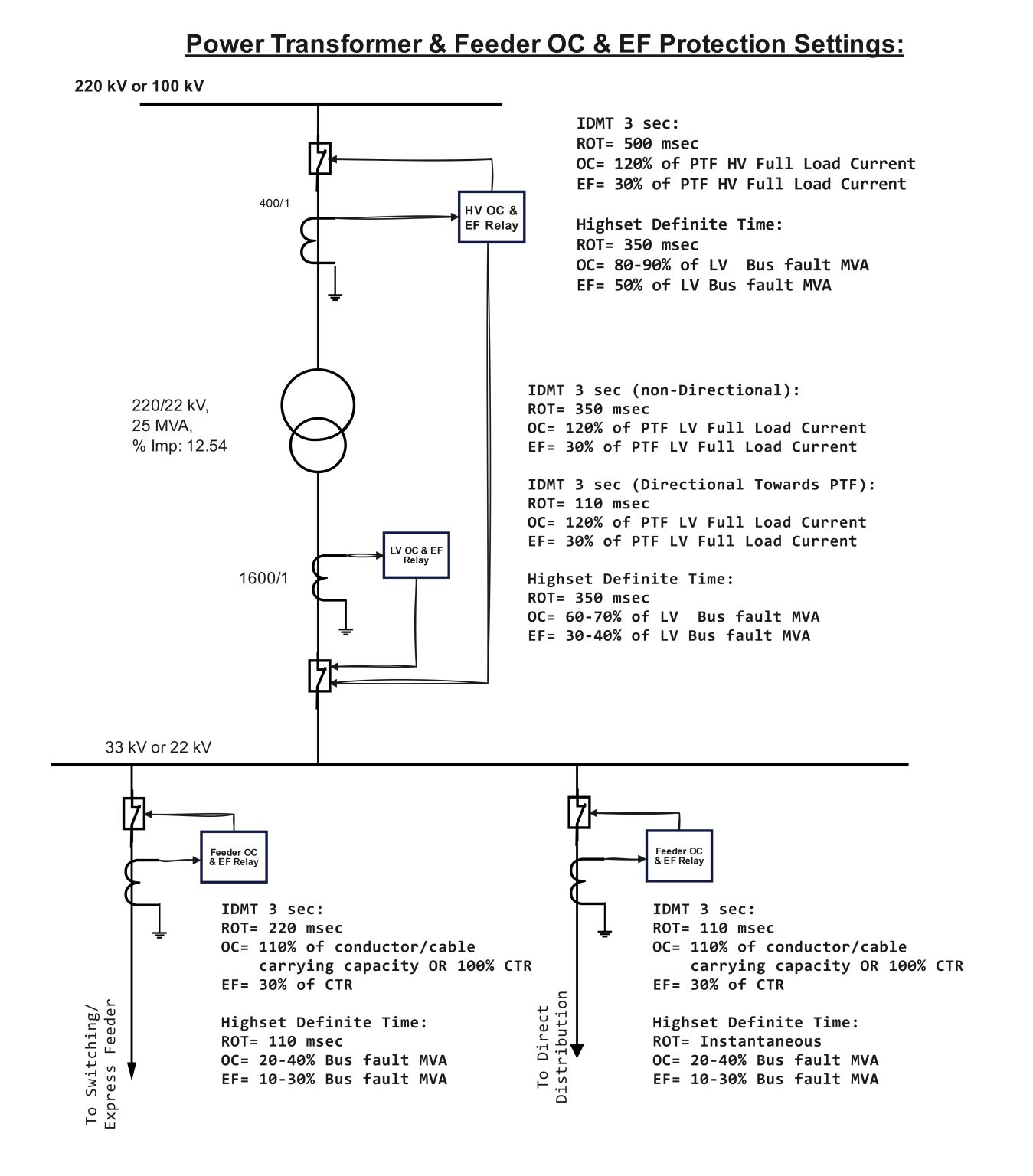
Protection coordination in EHV substations is not just about applying settings—it’s about ensuring reliability, speed, and selectivity under all fault conditions. A well-designed Overcurrent (OC) and Earth Fault (EF) protection scheme plays a critical role in achieving this balance.
This post shares a practical protection philosophy commonly used for power transformers and outgoing feeders.
What This Covers
- ✔️ Coordination between HV and LV sides
- ✔️ Application of IDMT and High Set elements
- ✔️ Use of Directional and Non-directional protection
- ✔️ Proper feeder coordination with transformer backup protection
Core Protection Philosophy
At the heart of every protection scheme lies a simple but powerful principle:
👉 Selectivity + Sensitivity + Speed = Reliable Protection
Each setting and relay function is designed to satisfy these three requirements without compromise.
Transformer Protection Approach
Transformer backup protection is typically designed considering:
- Full Load Current (FLC)
- System fault levels (fault MVA)
- Coordination with downstream feeders
Key Concepts:
🔹 Overcurrent (OC) Settings
Set above normal loading but sensitive enough to detect faults beyond the transformer zone.
🔹 Earth Fault (EF) Settings
More sensitive than OC to detect low-level ground faults effectively.
🔹 IDMT Characteristics
Provide time grading with feeders to ensure downstream faults are cleared first.
🔹 High Set Elements
Operate with minimal delay (or instantaneously) for severe faults close to the transformer.
Feeder Protection Strategy
Feeders are the first line of defense and must operate quickly to isolate faults.
Key Objectives:
🔹 Fast Fault Clearance
Prevents fault propagation and maintains system stability.
🔹 Avoid Transformer Tripping
Proper grading ensures that feeder relays operate before transformer backup protection.
🔹 Directional Protection (where required)
Ensures correct operation in interconnected or ring-fed systems.
Coordination Between Transformer & Feeders
Effective coordination ensures:
- Faults on feeders are cleared by feeder relays first
- Transformer protection acts only as backup
- Time delays are properly graded between:
- Feeder IDMT
- Transformer IDMT
- High set elements
Role of High Set Elements
High set (instantaneous or definite time) elements are crucial for:
- 🔸 Severe fault conditions
- 🔸 Close-in faults near the transformer
- 🔸 Providing fast backup when primary protection fails
These elements improve system safety by drastically reducing fault-clearing time in critical scenarios.
Final Thoughts
A well-coordinated OC & EF protection scheme ensures:
- ✔️ Reliability – Only the faulty section is isolated
- ✔️ Speed – Faults are cleared quickly
- ✔️ Selectivity – Healthy parts of the system remain unaffected
Designing such schemes requires a balance between protection sensitivity and operational security—something that comes with both calculation and field experience.