From Classroom to Grid: Why Per Unit Still Matters
Per-unit is one of those power-systems ideas that feels a bit abstract at first—like something designed more for textbooks than real grids. But the deeper you get into how utilities actually analyze and operate systems, the more practical sense it makes.
I found myself revisiting per unit while trying to understand power systems beyond classroom exercises. It kept appearing everywhere—in load flow studies, fault calculations, and system models—so it was hard to ignore. The obvious question became: why do engineers rely on it so heavily in real-world work?
The answer starts with how power systems are structured. In practice, electricity doesn’t stay at a single voltage level. Power might be generated at a certain voltage, transmitted at a much higher one, stepped down through transformers, and finally delivered to loads at distribution levels.
If you stick strictly to actual units—volts, amps, ohms—you constantly have to “refer” quantities from one side of a transformer to another. That quickly becomes tedious and error-prone, especially in large systems.
This is where per unit earns its keep.
Expressing quantities relative to a chosen base (instead of in absolute terms) puts everything on a common scale. When base voltages are selected consistently across transformer ratios, values naturally line up across different voltage levels. Suddenly, the system becomes much easier to analyze as a whole rather than as disconnected pieces.
That’s a big reason per unit shows up so often in utility studies—it simplifies comparisons and removes a lot of unnecessary conversion work.
A quick example
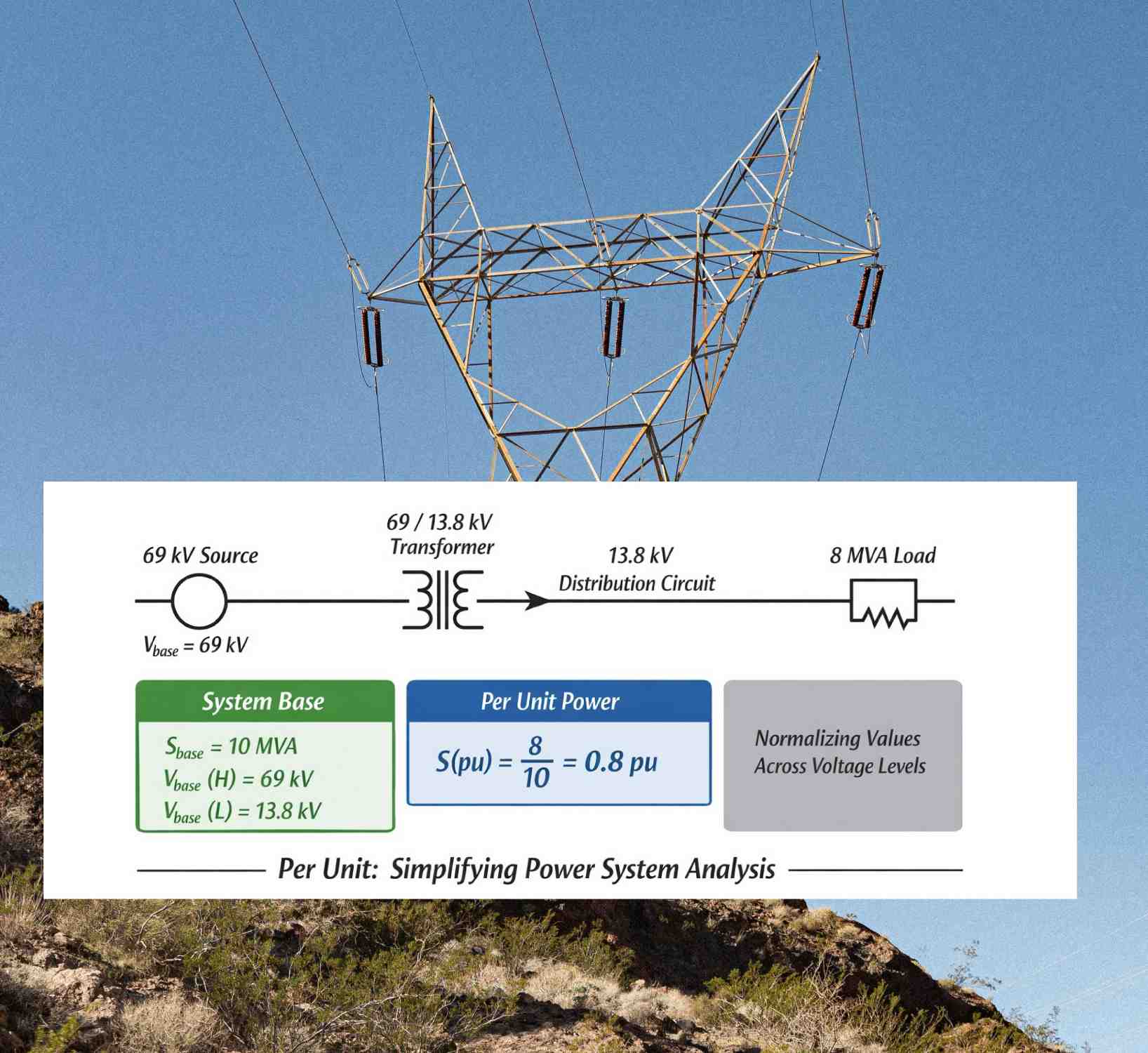
Consider a simple system:
- A three-phase 69 kV source
- A 69/13.8 kV transformer
- A 13.8 kV feeder supplying an 8 MVA load
Now choose base values:
- Base power = 10 MVA
- Base voltage (high side) = 69 kV
- Base voltage (low side) = 13.8 kV (set by the transformer ratio)
The per-unit apparent power is then:
Spu = 8/10 = 0.8 pu
That’s it. Instead of tracking values separately on each side of the transformer and converting between them, everything lives on the same normalized scale. Per unit isn’t just a mathematical trick—it’s a practical tool. It reduces complexity, improves consistency, and makes large systems easier to reason about. Once you start thinking in per unit, it stops feeling academic and starts feeling like a shortcut that engineers genuinely depend on.