Engineering Guide: Professional Termination of Medium and High Voltage Cables
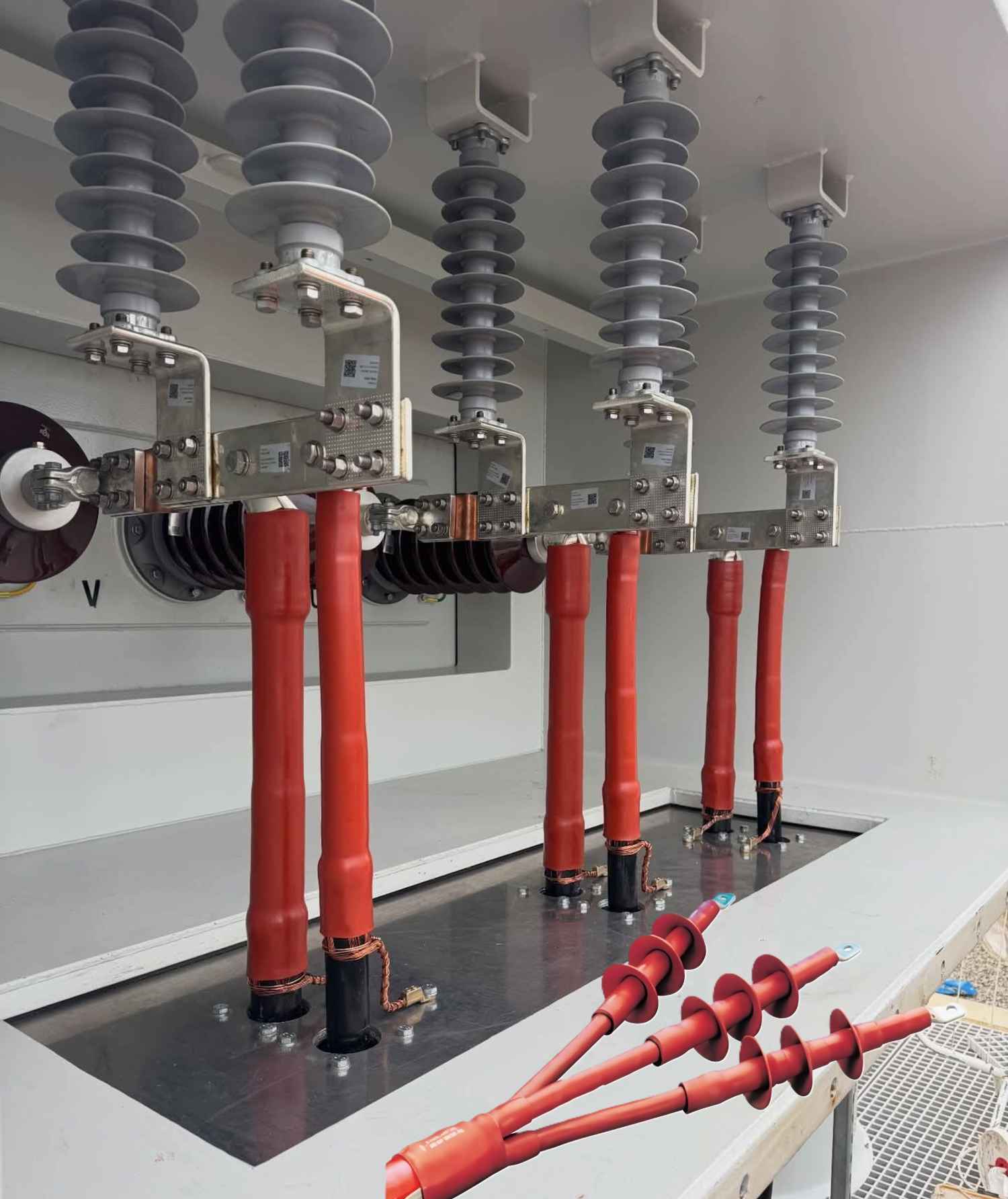
Cable termination is a critical phase in electrical infrastructure projects, serving as the interface between the controlled environment of a shielded cable and the open environment of switchgear, transformers, or busbars. According to IEEE 48 and IEC 60502-4, any minor deviation in the termination process can lead to Partial Discharge (PD), tracking, or catastrophic failure. This guide outlines the professional standards and technical specifications required for high-reliability terminations.
1. Professional Termination Methodology
The integrity of a termination depends on the precise management of the cable’s dielectric layers and the mitigation of electrical stress.
1.1 Environmental Control and Preparation
The work area must be a “clean zone,” free from dust, metallic particles, and moisture. Contaminants on the insulation surface can create conductive paths under high-voltage stress.
- Cleaning Protocol: Use 99% Isopropyl Alcohol wipes. The cleaning must be unidirectional—from the conductor toward the cable shield—to prevent contaminants from being dragged back onto the primary insulation (XLPE).
- Surface Inspection: After cleaning, the XLPE surface must be inspected for any “pitting” or embedded particles.
1.2 Semi-conductive Layer Stripping (Critical Step)
The transition from the semi-conductive screen to the primary insulation is the most vulnerable point for electrical failure.
- Precision Tools: Use dedicated rotary stripping tools rather than manual knives. A manual knife can cause longitudinal nicks in the XLPE, which act as “stress risers” leading to electrical tracking.
- Cut Quality: The cut must be perfectly square. Any “step” or jagged edge at the conductor terminus will cause a localized concentration of the electric field, triggering PD.
1.3 Electrical Stress Control
When the insulation shield is removed, the electric field lines, which were previously radial and uniform, become concentrated at the shield’s edge.
Stress Control Mechanisms:
- Geometric Control: Utilizing a Stress Cone to physically change the shape of the electric field.
- Capacitive/Refractive Control: Using High-K (High Permittivity) materials (tubes or tapes) to “refract” and spread the field lines over a larger area.
- Application: Ensure the stress control element overlaps the semi-con edge by the exact distance specified in the manufacturer’s kit (typically 15-25mm).
1.4 Mechanical Connection and Sealing
- Crimping: Use Hydraulic Compression with hexagonal dies matched to the conductor size and material (Copper vs. Aluminum). Two or more compressions are required to ensure low contact resistance and prevent “hot spots.”
- Moisture Sealing: Apply Mastic Sealing Tapes at the lug base and the cable breakout. Moisture ingress into the cable core can lead to “water treeing” in the XLPE insulation over time.
2. Technical Specifications and Critical Clearances
Adherence to minimum clearance distances is mandatory to prevent phase-to-phase or phase-to-ground flashovers.
| Voltage Level (kV) | Min. Phase-to-Phase Clearance (mm) | Min. Phase-to-Ground Clearance (mm) | IEEE 48 Class Requirement |
| 11 kV | 185 mm | 150 mm | Class 1 (Outdoor) / Class 2 (Indoor) |
| 33 kV | 355 mm | 320 mm | Class 1 (Outdoor) / Class 2 (Indoor) |
- Creepage Distance: In polluted or coastal environments, the creepage distance (the distance along the insulator’s surface) must be increased to prevent leakage currents.
- Heat Shrink Uniformity: When using heat-shrinkable components, use a soft-flame torch. Shrink from the bottom up to expel air and prevent Air Pockets, which are primary sites for PD.
3. Post-Termination Testing: Insulation Resistance (IR) & PI
Before energizing, the termination must undergo a DC High-Potential or Insulation Resistance test to verify the dielectric integrity.
3.1 Test Parameters
- Test Voltage: For 11kV/33kV systems, a 5000V DC Megger is standard.
- Safety: The cable must be fully discharged before and after testing. Large cables act as capacitors and can store lethal energy.
3.2 Result Interpretation (IEEE 43 Standards)
The Polarization Index (PI) is the most reliable indicator of insulation health, as it accounts for the absorption current of the dielectric.
| Metric | Formula | Acceptable Value | Engineering Significance |
| Insulation Resistance (IR) | Reading at 1 min | > 1000 MΩ | Indicates surface cleanliness and dryness. |
| Polarization Index (PI) | R10 min / R1 min | > 2.0 | Indicates a healthy, dry, and non-degraded dielectric. |
| Dielectric Absorption (DAR) | R60 sec / R30 sec | > 1.4 | Useful for quick assessment of moisture presence. |
Engineering Alert: A PI value < 1.0 indicates that the insulation is contaminated or wet. In such cases, the termination must be inspected, cleaned, or redone. Energizing a cable with a low PI significantly increases the risk of an immediate explosive failure.