Insulation Materials Used in Transformers and Induction Motors
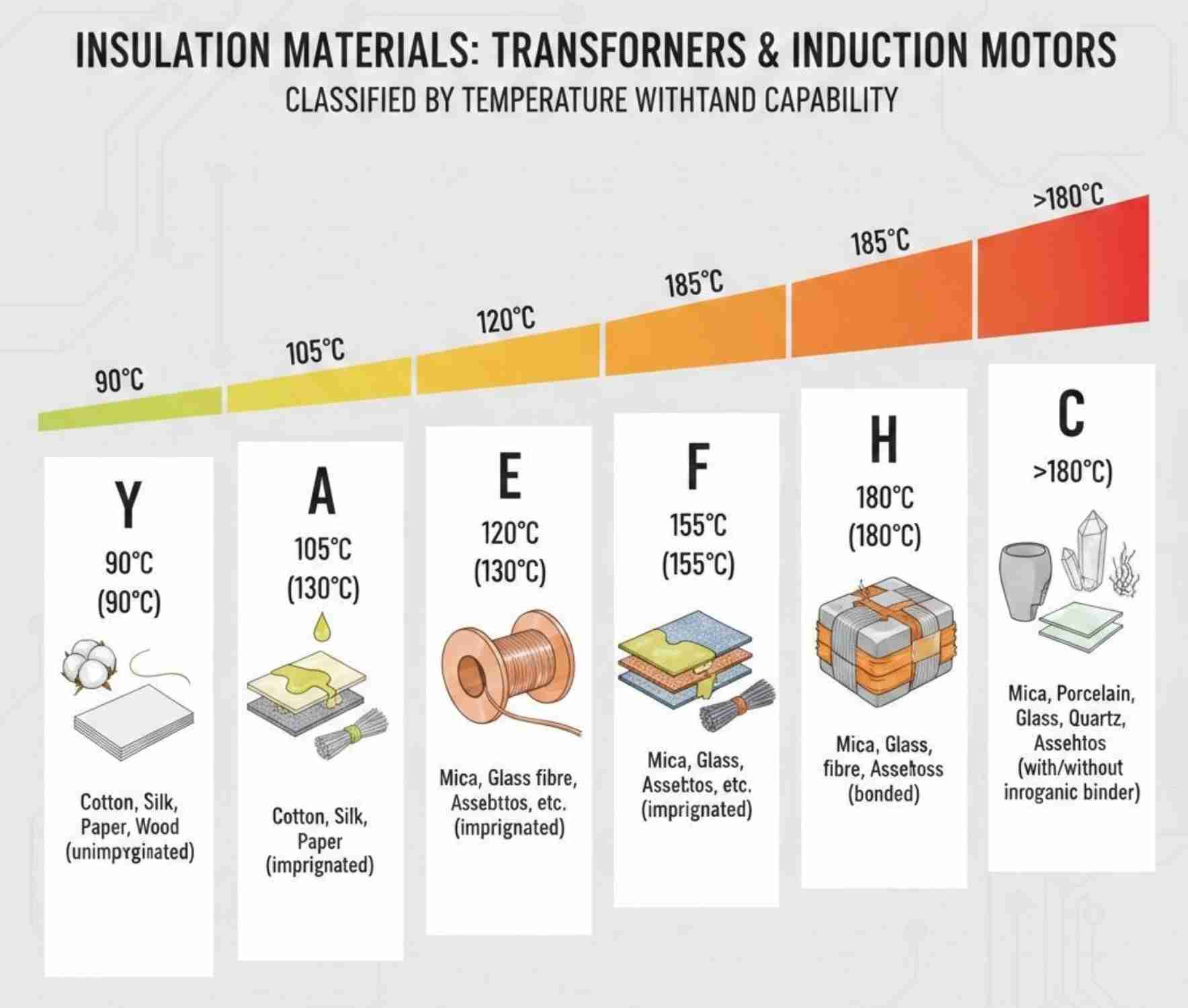
Insulation plays a critical role in the performance, safety, and lifespan of electrical equipment such as transformers and induction motors. Since these machines operate under varying electrical and thermal stresses, the insulation system must withstand high temperatures without deteriorating. To standardize insulation performance, materials are classified by their maximum permissible hot-spot temperature—the highest temperature reached within the winding. Choosing the correct insulation class ensures reliability, efficiency, and long service life.
Let’s explore the major insulation classes used in transformers and induction motors.
🔹 Class Y Insulation (Up to 90°C)
Class Y insulation is designed for lower temperature applications.
Maximum hot-spot temperature: 90°C
Typical materials used:
- Cotton
- Silk
- Paper
- Wood (without impregnation)
These materials are organic and untreated, making them suitable only for applications where operating temperatures remain relatively low.
🔹 Class A Insulation (Up to 105°C)
Class A insulation offers improved thermal endurance compared to Class Y.
Maximum hot-spot temperature: 105°C
Typical materials used:
- Cotton (impregnated)
- Silk (impregnated)
- Paper (impregnated)
Impregnation with insulating varnishes or oils enhances thermal stability and dielectric strength, making these materials suitable for moderate-temperature electrical machines.
🔹 Class E Insulation (Up to 120°C)
Class E insulation provides higher thermal stability than Class A.
Maximum hot-spot temperature: 120°C
Typical materials used:
- Enamel-coated wires
- Synthetic insulating materials with improved thermal characteristics
These materials can safely operate at temperatures approximately 15°C higher than Class A insulation systems.
🔹 Class B Insulation (Up to 130°C)
Class B insulation is commonly used in many industrial motors and transformers.
Maximum hot-spot temperature: 130°C
Typical materials used:
- Mica
- Glass fiber
- Asbestos (with suitable impregnation or coating)
These materials are bonded with insulating varnishes or resins to enhance mechanical strength and thermal endurance.
🔹 Class F Insulation (Up to 155°C)
Class F insulation is widely used in modern electrical machines where higher temperature performance is required.
Maximum hot-spot temperature: 155°C
Typical materials used:
- Mica
- Glass fiber
- Asbestos
- High-temperature binding resins
These systems can withstand temperatures 25°C higher than Class B insulation.
🔹 Class H Insulation (Up to 180°C)
Class H insulation is designed for high-performance and heavy-duty applications.
Maximum hot-spot temperature: 180°C
Typical materials used:
- Mica
- Glass fiber
- Asbestos
- Special high-temperature bonding agents
These materials are carefully bonded to maintain electrical and mechanical integrity at elevated temperatures.
🔹 Class C Insulation (Above 180°C)
Class C insulation is used in extremely high-temperature environments.
Maximum hot-spot temperature: Above 180°C
Typical materials used:
- Mica
- Porcelain
- Glass
- Quartz
- Asbestos (with or without inorganic binders)
These materials are largely inorganic and can withstand very high thermal stress without degradation.
Why Insulation Class Matters
Selecting the correct insulation class is essential for:
- Extending equipment lifespan
- Preventing insulation breakdown
- Improving operational reliability
- Reducing maintenance costs
- Ensuring safe operation under thermal stress
Modern transformers and induction motors often use Class F or Class H insulation to handle higher power densities and compact designs.
Insulation systems are the backbone of transformers and induction motors. As operating temperatures increase with higher power demands, selecting the right insulation class becomes even more critical. Understanding these classifications helps engineers design safer, more efficient, and longer-lasting electrical machines.