Industrial Electrical Grounding – Not Optional, It’s Critical
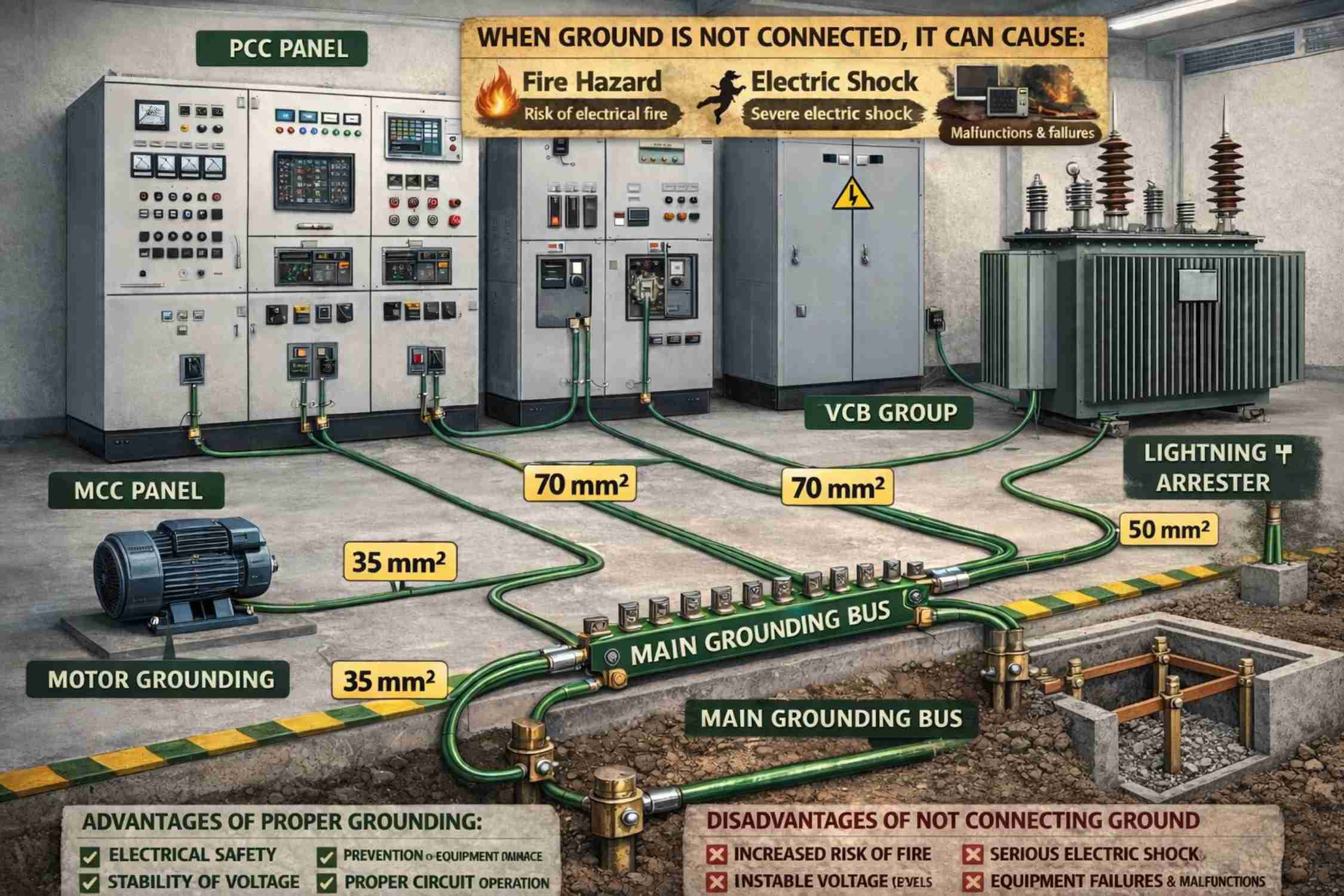
In the world of industrial power systems, there is a common saying: “Grounding is the silent sentinel.” When it is designed and installed correctly, you never notice it. But the moment it fails, the consequences can range from catastrophic equipment damage to fatal injuries.
Recently, I came across an illustration that perfectly captures the complexity of a robust industrial grounding architecture. It depicted a facility integrating PCC (Power Control Center), MCC (Motor Control Center), and VCB (Vacuum Circuit Breaker) panels, motors, transformers, and lightning arresters—all bonded to a common grounding grid using RCC earth pits and copper flats.
This illustration serves as a perfect blueprint for why grounding is not just a regulatory checkbox, but the foundation of safety and reliability.
🔧 What an Effective Grounding System Looks Like
A complete system isn’t just a copper rod hammered into the dirt. It is a holistic network that includes:
- PCC and MCC Panel grounding – Ensuring control centers have a zero-reference point.
- VCB Group grounding – Critical for arc suppression and reliable tripping.
- Motor body grounding – Preventing surface potential from becoming a lethal hazard.
- Transformer neutral & body grounding – Stabilizing the entire distribution system.
- Lightning arrester grounding – Providing a dedicated (but bonded) path for surge energy.
- Main grounding bus – The central hub for all bonding connections.
- RCC earth pits with copper flat grid – Creating a low-resistance mat under the facility.
- Multiple earth electrodes (parallel grounding) – Ensuring redundancy.
⚠️ A Critical Reality Check
Grounding effectiveness is NOT only about cable size. While thick copper is important, the real magic lies in achieving a low-resistance path, ensuring continuity of bonding, building in redundancy, and executing a well-thought-out grid design. A thick cable with a loose connection is worse than no cable at all.
✅ The Advantages of Proper Grounding
Investing in a proper grounding system pays dividends across the entire operation:
- Personnel Safety: It provides a low-impedance path to earth, preventing fatal electric shocks by ensuring that fault current doesn’t flow through a human body.
- Fast Fault Clearance: It ensures that breakers and relays see the fault current instantly, operating correctly to isolate the issue before damage spreads.
- Fire Prevention: By quickly clearing faults, it prevents cable overheating and insulation failure that can lead to electrical fires.
- Stable Voltage Reference: Modern industrial plants rely on sensitive electronics, PLCs, and VFDs. A stable ground provides a consistent zero-voltage reference, preventing erratic behavior and data corruption.
- Equipment Life Extension: Motors, transformers, and VFDs experience less stress with a solid ground reference, significantly extending their operational lifespan.
- Lightning Surge Protection: It safely dissipates the massive energy of a lightning strike, diverting it away from expensive switchgear and transformers.
- Reduced EMI & Noise: A proper grid minimizes electromagnetic interference, which is crucial for the reliability of control and instrumentation circuits.
❌ The High Cost of a “Missing” Ground
When the ground is not connected—or is poorly implemented—the system becomes a liability. The disadvantages are immediate and severe:
- High Risk of Electric Shock ⚡ – The most immediate danger to operators and maintenance staff.
- Electrical Fire Hazards 🔥 – Overheating conductors and arcing faults without a clear path to ground.
- Frequent Equipment Failures – Unexpected breakdowns of motors, drives, and control panels.
- Unstable Voltage & False Tripping – Nuisance trips in breakers and erratic behavior in PLCs, leading to costly downtime.
- Lightning Damage – Panels and transformers become “sitting ducks” for surge damage.
- Motor Bearing & Insulation Failure – Shaft voltages and circulating currents destroy bearings if not properly grounded.
- Unreliable Protection System Operation – The worst-case scenario: a fault occurs, but the breaker fails to trip because the ground path is too resistive.
🏗 Best Practices Highlighted
Based on the architecture seen in the reference illustration, here are the non-negotiable best practices for industrial grounding:
- Common Bonding: Use a common grounding bus for all equipment. Isolated grounds can create potential differences that lead to arcing.
- Segregation with Bonding: While separate lightning arrester grounding is often used to keep surge noise away from sensitive electronics, it must still be bonded to the main grid to equalize potential during a strike.
- The Grid: Utilize RCC (Reinforced Cement Concrete) earth pits with a copper flat grid inside. This creates a large surface area contact with the earth, drastically lowering resistance.
- Redundancy: Rely on multiple earth points (parallel grounding). If one electrode corrodes or dries out, the others maintain the system’s integrity.
- Bonding over Size: Focus on proper bonding techniques. A clean, tight connection is more critical than simply upsizing the cable.
💡 The Bottom Line
Good grounding is invisible when it works, but disastrous when it doesn’t. It is the backbone of industrial safety, the protector of capital equipment, and the enabler of reliable production.
Whether you are dealing with a 500kW motor, a sensitive PLC rack, or a high-voltage VCB panel, the principles remain the same. As we push toward more complex systems involving EV Infrastructure, Renewable Energy, and BMS (Battery Management Systems), the importance of a solid, low-resistance, and redundant grounding architecture continues to grow.
Safety-driven design and system reliability are not just engineering goals—they are responsibilities.