Circuit Breakers in Power Transmission Substations: A Detailed Classification and Analysis
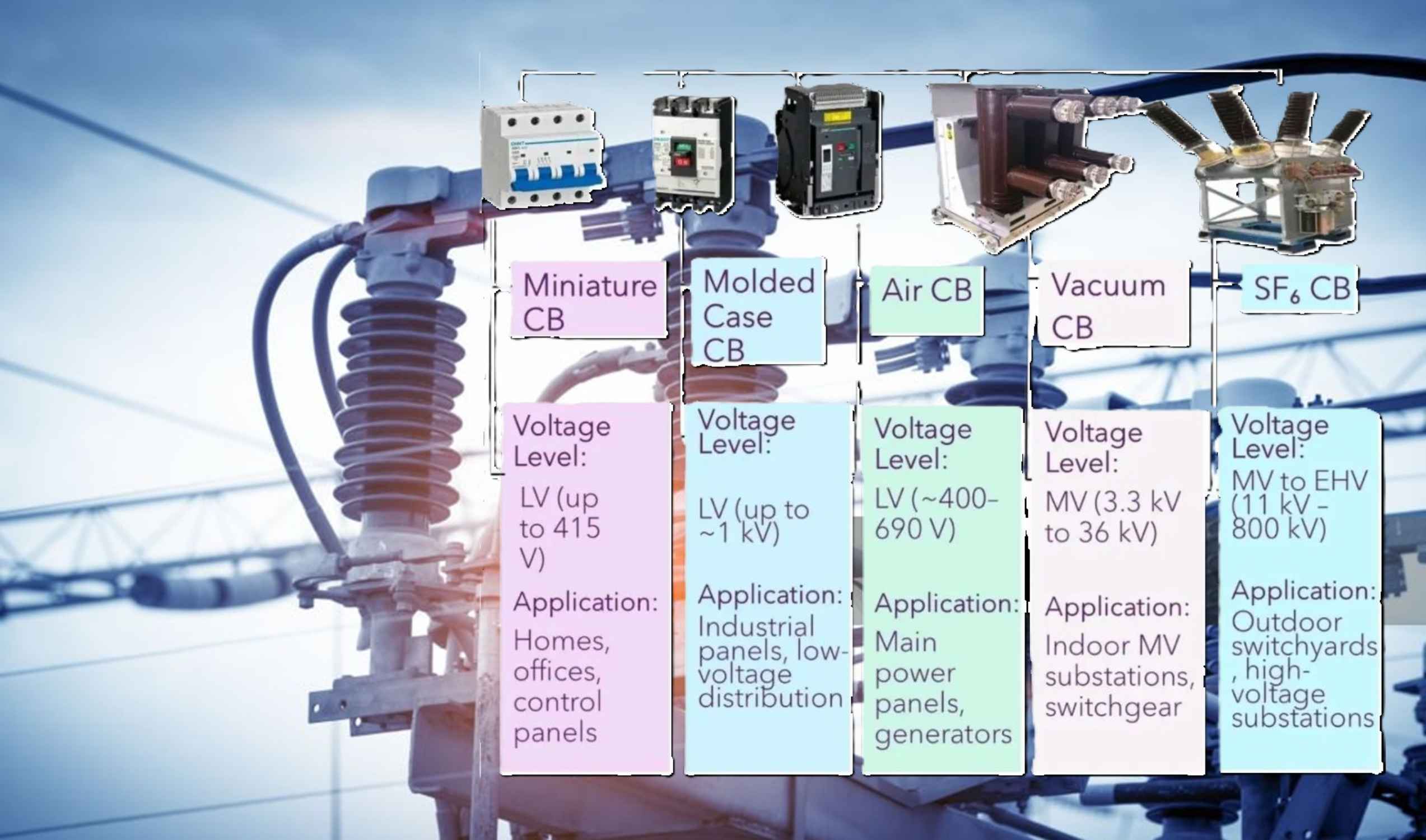
Circuit breakers (CBs) are critical components in electrical power transmission substations, serving as protective devices that interrupt fault currents and control power flow. Their classification is typically based on three main criteria: Rated Voltage, Medium of Arc Extinction, and Operating Mechanism. A detailed understanding of the arc-extinction medium is paramount, as it dictates breaker performance and suitability for high-voltage applications.
1. Classification by Medium of Arc Extinction
The primary function of a circuit breaker is to extinguish the electric arc that forms between the separating contacts when a current is interrupted. The medium used to cool and de-ionize the arc plasma is the most significant differentiator between CB types.
A. Sulfur Hexafluoride SF6Circuit Breakers
SF6 gas circuit breakers are the dominant technology in modern high-voltage (HV) and extra-high-voltage (EHV) transmission systems (typically 72.5 kV).
- Principle of Operation: SF6 gas possesses exceptional dielectric strength (approximately 2.5 times that of air) and superior heat transfer properties. When the contacts separate, the gas is compressed and then blown across the arc, rapidly cooling and de-ionizing the plasma, which extinguishes the arc at the current zero crossing.
- Advantages:
- High Performance: Excellent arc quenching capability, making them suitable for interrupting very high fault currents.
- Reliability and Low Maintenance: They are typically sealed, minimizing external contamination and requiring significantly less maintenance compared to older technologies.
- Compactness: Due to the high dielectric strength of SF6, the size of the interrupter unit is relatively small.
- Environmental Concerns and Modern Trends: SF6 is a potent greenhouse gas, with a Global Warming Potential (GWP) approximately 23,500 times that of CO2 over a 100-year period. This has led to stringent regulations and a strong industry drive toward SF6-free or Green Gas technologies. These alternatives often use mixtures of gases such as CO2, O2, and N2, or new fluorinated gases with significantly lower GWPs, aiming to match SF6 performance while reducing the environmental footprint.
B. Vacuum Circuit Breakers (VCBs)
VCBs are the preferred choice for medium-voltage (MV) applications (up to about 38 kV) and are increasingly being developed for higher voltages.
- Principle of Operation: The contacts operate within a sealed, high-vacuum chamber. The vacuum acts as the arc-extinguishing medium. When the contacts separate, an arc forms from metal vapor between them. In high vacuum, the metal vapor rapidly diffuses, and the arc is extinguished at the current zero crossing.
- Advantages:
- Extremely Long Life: The contacts are protected from oxidation, leading to a very long operational life and minimal maintenance.
- Environmentally Friendly: They are non-polluting and non-flammable.
- Fast Operation: VCBs offer very fast interruption times.
C. Air Blast Circuit Breakers (ABCBs)
ABCBs were historically used in high-voltage systems but have been largely superseded by SF6 technology.
- Principle of Operation: A high-pressure blast of compressed air is directed at the arc to extinguish it.
- Disadvantages: They are noisy, require a complex, costly compressed air system (compressors, storage tanks, piping), and require higher maintenance.
D. Oil Circuit Breakers (OCBs)
OCBs, which use insulating oil as the arc-extinguishing medium, are considered obsolete in modern transmission substations.
- Principle of Operation: The heat of the arc vaporizes the surrounding oil, generating a high-pressure gas bubble (mostly hydrogen) that blasts the arc and extinguishes it.
- Disadvantages: They pose a fire hazard, require frequent maintenance (oil filtration and replacement), and have slower interruption times than SF6 and vacuum breakers.
The table below summarizes the practical application range of the main CB types based on the arc extinction medium:
| Circuit Breaker Type | Arc Extinction Medium | Typical Voltage Range | Status in Modern Transmission |
|---|---|---|---|
| SF6 | Sulfur Hexafluoride Gas | MV, HV, EHV (up to 1200 kV | Dominant, Industry Standard |
| Vacuum (VCB) | High Vacuum | MV up to 38 kV | Dominant in MV, Emerging in HV |
| Air Blast (ABCB) | Compressed Air | HV, EHV | Largely Obsolete |
| Oil (OCB) | Insulating Oil | MV, HV | Obsolete |
2. Classification by Operating Mechanism
The operating mechanism provides the mechanical force required to rapidly open and close the circuit breaker contacts. The speed and reliability of this mechanism are crucial for effective protection.
A. Spring-Charged Mechanism (Motor-Spring)
This is the most common and reliable mechanism used in modern circuit breakers, especially in SF6 and VCBs.
- Operation Cycle:
- A small electric motor charges a closing spring by compressing it.
- When a closing command is issued, the stored energy in the closing spring is released to close the contacts.
- Simultaneously, the closing action mechanically charges the opening (or tripping) spring.
- When a tripping command is issued (either by a protective relay or manually), the stored energy in the opening spring is released, rapidly separating the contacts.
- Key Advantage: The mechanism ensures that the energy required for the critical tripping operation is always stored and ready, independent of the control power supply (motor). If the motor fails, the breaker can still trip (open) using the stored energy, but it cannot be reclosed until the motor is repaired or the spring is manually charged.
B. Pneumatic Mechanism
This mechanism uses high-pressure compressed air to operate the contacts.
- Usage: Historically used with Air Blast Circuit Breakers.
- Disadvantages: The complexity and maintenance of the associated air-compression system, along with potential issues such as air leaks and moisture contamination, have led to its decline in favor of the simpler, more reliable motor-spring mechanism.
C. Hydraulic Mechanism
This mechanism uses pressurized oil to operate the contacts. While offering high operating forces and speed, it is less common than the spring mechanism due to potential oil leakage and complexity.
3. The Best Type of Circuit Breaker
Based on current industry standards, performance, and reliability, the SF6 Circuit Breaker is considered the best and most widely used type for high-voltage and extra-high-voltage transmission substations.
Reasons for SF6 Dominance:
- Superior Arc Quenching: Unmatched ability to interrupt high fault currents quickly and reliably.
- High Reliability: Sealed design leads to minimal maintenance and high operational availability.
- Fast Operation: Supports the rapid interruption times required for system stability in critical networks.
However, the future trend is moving towards SF6-free (Green Gas) Circuit Breakers. These new technologies are rapidly closing the performance gap while offering a sustainable, environmentally responsible alternative, making them the preferred choice for new projects in regions with strict environmental regulations.
References
- Intergovernmental Panel on Climate Change (IPCC). Climate Change 2021: The Physical Science Basis.
- CIGRE Technical Brochure 780. SF6 Replacement Gases. (2019).