Causes, Impact, and Mitigation of Harmonics in Power Systems
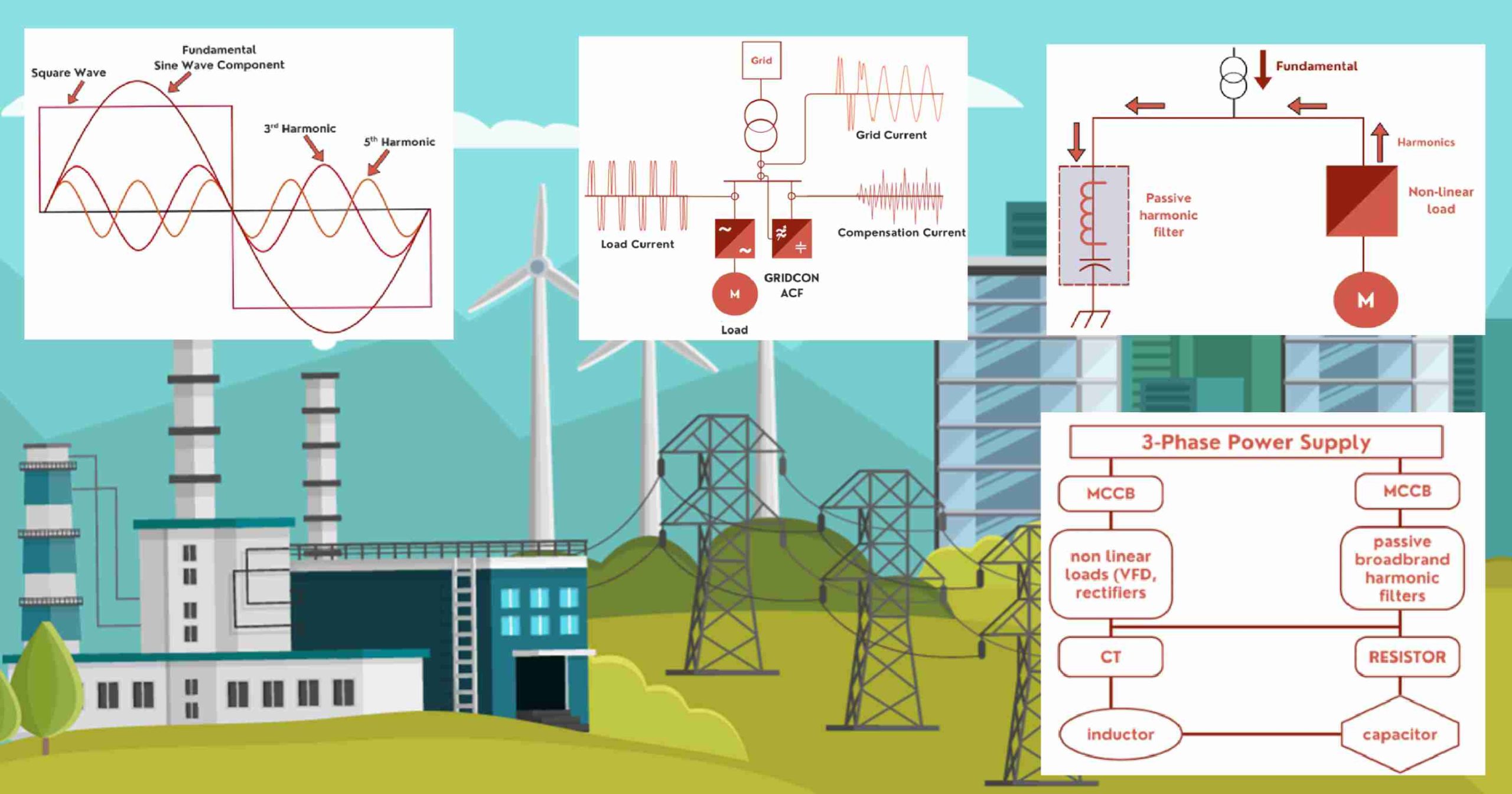
In an ideal power system, electricity flows in a smooth, sinusoidal waveform at a fundamental frequency—typically 50 Hz or 60 Hz. However, in real-world installations filled with computers, LED lighting, variable speed drives, and renewable energy inverters, that smooth waveform often becomes distorted. These distortions are known as harmonics—unwanted “extra waves” that ride on top of the fundamental frequency. While they may seem invisible, their effects are far from harmless. Harmonics can overheat equipment, reduce efficiency, cause nuisance tripping, and even damage sensitive devices. In this article, we explore the causes, impact, and mitigation strategies for harmonics in power systems.
Understanding Harmonics: The Basics
What Are Harmonics?
Harmonics are voltage or current components that occur at integer multiples of the fundamental frequency.
For example, in a 50 Hz system:
- 3rd harmonic = 150 Hz
- 5th harmonic = 250 Hz
- 7th harmonic = 350 Hz
In a 60 Hz system:
- 3rd harmonic = 180 Hz
- 5th harmonic = 300 Hz
When electrical loads are non-linear, they draw current in abrupt pulses instead of smooth waves. This distorts the waveform and introduces harmonic frequencies.
Importantly, harmonic currents do not contribute to useful work. Instead, they circulate through the system, creating heat, losses, and equipment stress.
Fourier Analysis and Harmonics
Engineers analyze harmonics using Fourier analysis, a mathematical technique that breaks a distorted waveform into:
- The fundamental frequency
- Its integer harmonic components
This decomposition helps identify which harmonics are present (3rd, 5th, 7th, etc.) and how severe they are. With this information, targeted mitigation strategies can be implemented.
Types of Harmonics
Harmonics are generally categorized as:
- Odd harmonics
- Even harmonics
Odd vs. Even Harmonics
| Aspect | Odd Harmonics | Even Harmonics |
|---|---|---|
| Frequency | Odd multiples (3rd, 5th, 7th…) | Even multiples (2nd, 4th…) |
| Common Source | Non-linear loads (computers, VFDs) | Asymmetrical loads or faulty equipment |
| Prevalence | Very common | Rare |
| Neutral Impact | Significant (especially 3rd, 9th, 15th) | Minimal |
| Waveform Distortion | Symmetrical | Asymmetrical |
In most industrial and commercial systems, odd harmonics dominate.
Triplen Harmonics and Neutral Overloading
Triplen harmonics (3rd, 9th, 15th, etc.) are a special subset of odd harmonics.
In three-phase systems:
- Fundamental currents in each phase are 120° apart and cancel in the neutral.
- Triplen harmonics, however, are in phase with each other.
- Instead of canceling, they add together in the neutral conductor.
Why This Is Dangerous
Imagine a commercial building with:
- Hundreds of computers
- LED lighting
- Switching power supplies
Each produces 3rd harmonic currents. In the neutral conductor, these harmonic currents accumulate, potentially exceeding the phase conductor current.
This can lead to:
- Neutral conductor overheating
- Insulation breakdown
- Fire hazards
- System failure
Triplen harmonics are one of the most serious harmonic-related risks in modern buildings.
Key Harmonic Metrics
Total Harmonic Distortion (THD)
Total Harmonic Distortion (THD) measures the overall distortion in a waveform.
It compares the combined RMS value of all harmonics to the fundamental component.
High THD results in:
- Equipment overheating
- Reduced efficiency
- Poor power quality
- Premature failures
The IEEE standard IEEE 519 recommends:
- Voltage THD < 5%
- Current THD < 20% (depending on system size)
Individual Harmonic Distortion (IHD)
Individual Harmonic Distortion (IHD) measures the contribution of each harmonic relative to the fundamental.
This helps engineers identify:
- Which harmonic (3rd, 5th, 7th…) is dominant
- Whether specific mitigation is required
For example:
- 3rd harmonic → neutral overheating risk
- 5th harmonic → motor torque pulsations
- 7th harmonic → transformer stress
IHD analysis enables targeted filtering rather than generalized solutions.
Causes of Harmonics in Power Systems
Harmonics are primarily generated by non-linear loads, including:
- Variable Frequency Drives (VFDs)
- Switching power supplies
- Computers and data centers
- LED lighting systems
- Arc furnaces and welders
- Solar inverters
- Wind turbine converters
- Unbalanced loads
- Magnetic saturation in transformers
- Resonance conditions
- Half-wave rectifiers
- Faulty equipment
As modern systems increasingly rely on power electronics, harmonic generation continues to rise.
Impact of Harmonics on Power Systems
1. Equipment Overheating
Harmonics increase:
- Eddy current losses
- Hysteresis losses
- I²R losses
Transformers and motors operate at higher temperatures, which reduces their lifespan.
2. Neutral Conductor Overload
Triplen harmonics accumulate in the neutral, creating:
- Excessive current
- Overheating
- Fire hazards
3. Capacitor Bank Failures
Harmonics can cause:
- Resonance
- Overvoltage
- Excess current
Leading to capacitor damage or explosions.
4. Protection System Malfunction
Harmonics may:
- Cause nuisance tripping
- Prevent relays from operating correctly
- Distort measurement accuracy
This compromises system reliability.
5. Reduced Power Factor and Efficiency
Higher RMS currents increase:
- Resistive losses
- Energy consumption
- Utility penalties
Poor harmonic control directly increases operational costs.
6. Compliance and Safety Risks
Excessive harmonics can result in:
- Non-compliance with IEEE 519
- Regulatory penalties
- Increased arc flash risk
- Equipment downtime
Harmonics and Renewable Energy Integration
Renewable energy systems introduce new harmonic challenges.
Solar and wind installations rely heavily on inverters that use high-frequency switching. While efficient, these switching operations generate harmonic distortion.
Key challenges include:
- Grid resonance
- Relay malfunction
- Increased losses
- Reduced power factor
- Compliance difficulties with IEEE 519
Without proper filtering and grid design, harmonics can degrade the performance and stability of renewable energy systems.
Harmonic Mitigation Strategies
1. Passive Harmonic Filters
Passive filters use LC or LCR circuits tuned to specific harmonic frequencies.
Tuned Filters
- Target specific harmonics (5th, 7th, 11th)
- Low cost
- Suitable for predictable loads
Broadband Filters
- Address a wide range of harmonics
- Useful for multiple harmonic sources
Pros:
- Simple design
- Cost-effective
Cons:
- Fixed tuning
- Risk of resonance
2. Active Harmonic Filters (AHFs)
Active filters use IGBTs to inject equal and opposite harmonic currents in real time.
They:
- Continuously monitor the system
- Adapt to changing load conditions
- Cancel multiple harmonic frequencies simultaneously
Pros:
- Dynamic
- Wide frequency coverage
Cons:
- Higher cost
- Increased complexity
3. Capacitor Banks with Reactors
Used for:
- Power factor correction
- Basic harmonic mitigation
Reactors prevent harmonic amplification in capacitor banks.
Harmonic-Resistant Equipment
K-Rated Transformers
K-rated transformers are specifically designed to withstand harmonic currents without excessive overheating. They:
- Handle higher thermal stress
- Reduce insulation degradation
- Improve system reliability in non-linear environments
IEEE 519-Compliant Inverters
Modern inverters are designed to meet IEEE 519 limits:
- Minimize harmonic injection
- Improve waveform quality
- Protect grid stability
- Ensure regulatory compliance
Future Trends in Harmonic Mitigation
Solid-State Circuit Breakers
Fast-switching solid-state breakers:
- Detect and respond rapidly
- Improve protection in harmonic-rich systems
AI-Driven Harmonic Analysis
Machine learning is now being used to:
- Predict harmonic patterns
- Optimize filter settings in real time
- Adapt the inverter performance based on grid conditions
Advanced Semiconductor Technologies
New materials such as:
- Silicon Carbide (SiC)
- Gallium Nitride (GaN)
Enable:
- Faster switching
- Lower losses
- Improved waveform control
- Reduced harmonic generation
These technologies enable smaller filters and more stable integration of renewable energy.
Conclusion
Harmonics are no longer a niche power-quality issue—they are a defining challenge for modern electrical systems. From overheated transformers to neutral-conductor failures to difficulties with renewable integration, harmonic distortion can severely impact reliability, efficiency, and safety.
However, through:
- Proper harmonic analysis
- THD and IHD monitoring
- Compliance with IEEE 519
- Smart use of passive and active filtering
- Adoption of advanced inverter technologies
Power systems can achieve cleaner, safer, and more efficient operation.
As power electronics and renewable energy continue to expand, effective harmonic mitigation will remain essential to building resilient, future-ready electrical infrastructure.