A Comparative Analysis of AC and DC Power Transmission Systems: Technical Merits and Economic Trade-offs
Abstract
The architecture of modern electrical power systems is predominantly based on Alternating Current (AC), despite the inherent simplicity of Direct Current (DC). This article presents a quantitative analysis of the fundamental advantages of AC systems for power distribution, centered on the efficiency gains enabled by transformer-based voltage transformation. Using a simplified but representative case study, it compares the performance of equivalent DC and AC transmission links. The analysis demonstrates that while High-Voltage Direct Current (HVDC) transmission offers distinct advantages for specific, long-distance applications, the AC paradigm remains superior for general power distribution due to its flexibility, efficiency, and economic viability.
1. Introduction
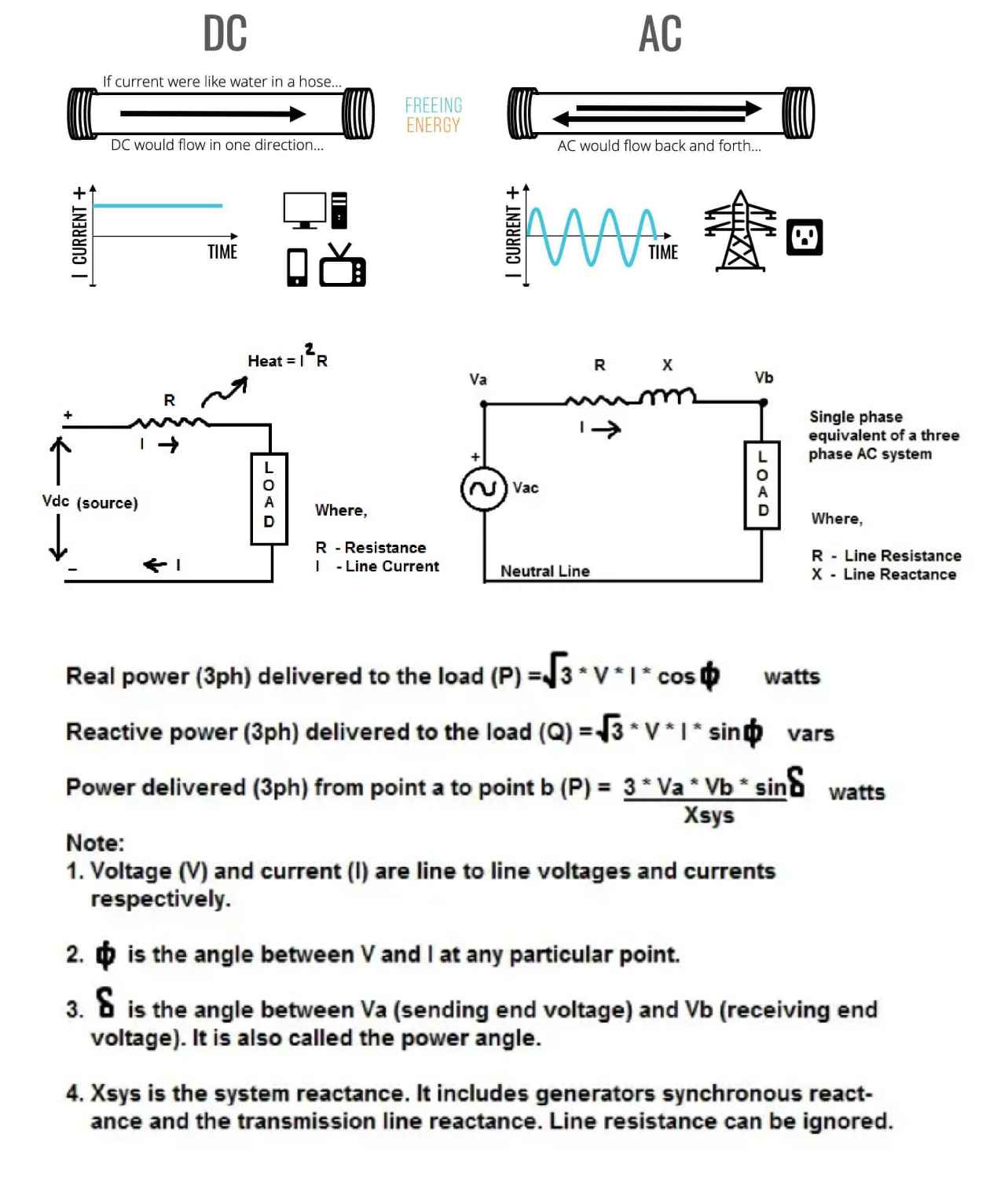
Electrical power systems are engineered to transmit energy from generation sources to consumption points with maximum efficiency and minimal loss. The core technological choice underpinning system design is whether to use Direct Current (DC), in which charge flows unidirectionally, or Alternating Current (AC), in which the direction of flow oscillates periodically. Historically, the “War of the Currents” was resolved in favor of AC systems, primarily due to the invention of the practical transformer. This paper elucidates the technical rationale for this outcome through a direct comparative analysis.
2. Case Study: Quantitative Comparison of Transmission Efficiency
Consider a scenario in which a power plant must deliver 48 kW (100 A at 480 V) to a load located 1000 feet away. Two systems are evaluated:
- A DC System, where 480 V DC is transmitted directly.
- An AC System, employing a step-up transformer (480 V to 4800 V) at the generation point and a step-down transformer (4800 V to 480 V) at the load point.
The comparative results are summarized in Table 1.
Table 1: Performance Comparison of DC and AC Transmission for a 48 kW, 1000 ft Link
| Parameter | DC System | AC System (with Transformation) |
|---|---|---|
| Line Current | 100 A | 10 A (after step-up) |
| Conductor Size | Larger diameter (low resistance ~0.15 Ω/1000ft) | Smaller diameter (higher resistance ~1.5 Ω/1000ft) |
| Voltage Drop (I·R) | 15 V | 15 V |
| Voltage Regulation | ~3.1% (495V to 480V) | ~0.3% (481.5V to 480V) |
| Transmission Loss (I²·R) | 1500 W | 150 W |
2.1 Analysis of Results
The primary advantage of the AC system is evident: voltage transformation enables current transformation. By increasing the transmission voltage tenfold, the required current is reduced by a factor of ten (P = V·I). This reduction has two critical consequences:
- Reduced Conductor Material: While the higher-resistance conductor for the lower AC has the same absolute voltage drop (15V), its smaller cross-section represents a significant saving in copper or aluminum.
- Dramatically Lower I²R Losses: Power losses in the transmission line are proportional to the square of the current (P_loss = I²R). Therefore, reducing the current by a factor of ten reduces the resistive losses by a factor of one hundred. In this example, AC losses are 150 W, compared with 1500 W for DC, a 90% reduction.
- Superior Voltage Regulation: The lower percentage voltage variation in the AC system (<0.3% vs. ~3.1%) ensures more stable voltage at the load, a key quality-of-power metric.
Furthermore, AC transformers operate with efficiencies exceeding 99% at full load. Achieving similar voltage transformation in a DC system has historically required inefficient motor-generator sets or rotary converters, though modern power electronics have addressed this in HVDC systems.
3. Applications and Limitations of DC Power Systems
Despite the distribution disadvantages, DC systems have critical niche applications, primarily in High-Voltage Direct Current (HVDC) transmission.
Advantages of HVDC:
- Economics of Long-Distance Transmission: For distances exceeding several hundred kilometers, the lower cost of the transmission line infrastructure (fewer conductors, narrower right-of-way) can offset the high capital cost of the AC/DC converter stations at each terminal.
- Asynchronous Interconnections: HVDC links can connect two AC power grids operating at different frequencies or that are not synchronized, thereby preventing fault propagation and instability.
- Subsea Cables: DC avoids the pronounced capacitive charging current losses inherent in long AC submarine cables.
- Controllability: Power flow in an HVDC link can be rapidly and precisely controlled.
Disadvantages of DC Systems:
- Distribution Inflexibility: The inability to use simple, passive transformers makes DC economically infeasible for the final, multi-voltage-tiered distribution to end users.
- High Conversion Costs: The requisite AC-DC (rectifier) and DC-AC (inverter) converter stations are complex and expensive, often costing hundreds of millions of dollars.
4. The Dominance and Complexity of AC Power Systems
The three-phase AC system represents an optimal balance between power delivery capability and infrastructure cost. Its advantages are foundational:
- Flexibility: Transformers enable efficient voltage stepping at generation (transmission-level voltages), along transmission, and at distribution (utilization voltages).
- Robust Generation: AC synchronous generators are mechanically simpler and more robust than historical DC generators, which required commutators and brushes.
However, AC systems introduce complexity not present in DC networks. The time-varying nature of AC gives rise to reactance (both inductive and capacitive), leading to the concept of reactive power. While reactive power performs no real work, it is essential for maintaining the magnetic fields in transformers and motors and for supporting voltage levels across the network. System stability is also more acute, requiring all interconnected generators to remain precisely synchronized in frequency.
5. Conclusion
The choice between AC and DC is not a matter of absolute superiority but of application-specific optimization. The analysis confirms that for the general task of power distribution—involving multiple voltage transformations and delivery to a vast network of dispersed loads—the AC system is demonstrably more efficient, economical, and flexible. The core enabling technology is the transformer, which allows efficient manipulation of voltage and current levels to minimize transmission losses.
Conversely, DC technology finds its competitive advantage in specialized, point-to-point, high-power, long-distance transmission and asynchronous interconnections, where its unique characteristics justify the substantial investment in power electronic conversion interfaces. Consequently, a modern, resilient, and efficient power grid is not an AC or DC system, but a hybrid that strategically employs both technologies to leverage their respective strengths.