Understanding the X/R Ratio and Its Importance in Short-Circuit Calculations
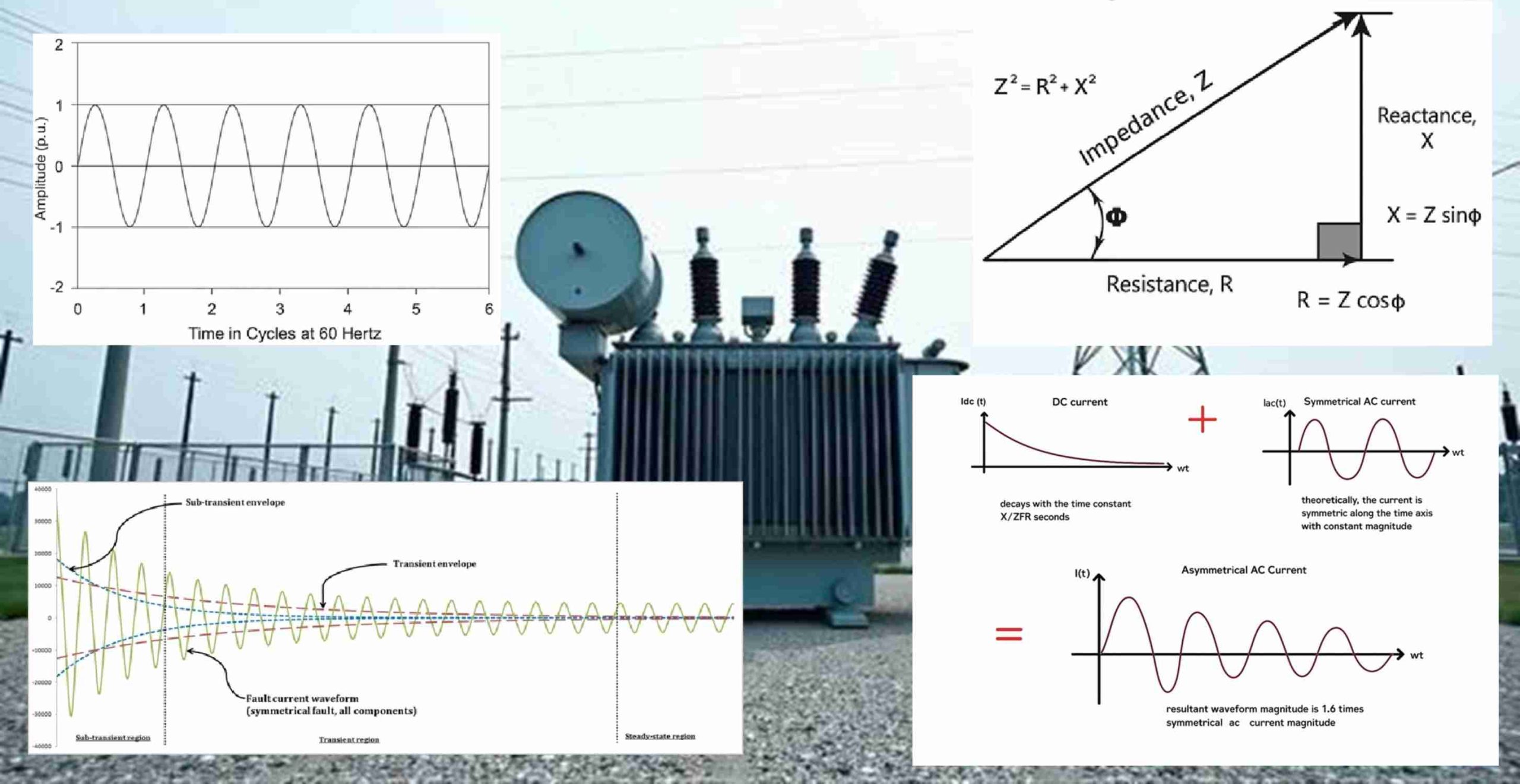
For an electrical power system to remain safe and reliable, short circuits must be accurately analyzed and properly managed. One of the most critical parameters in short-circuit studies is the X/R ratio. Though it may seem like a simple numerical value, it significantly influences fault current magnitude, waveform shape, equipment stress levels, and protective device selection. A clear understanding of the X/R ratio allows engineers to design stronger protection systems and correctly specify equipment ratings—ensuring both operational efficiency and long-term reliability of the electrical grid.
What Is the X/R Ratio?
In power systems, the X/R ratio represents the ratio of reactance (X) to resistance (R) within system components such as:
- Transformers
- Transmission lines
- Generators
- Motors
It defines how a system behaves during fault conditions—especially short circuits.
tan(ϕ) = X/R
Where:
- X = Reactance
- R = Resistance
- ϕ (phi) = Phase angle
The phase angle can be calculated as:
ϕ = tan-1(X/R)
Understanding R, X, and Impedance
Resistance (R)
Resistance is the opposition to the flow of current when a voltage is applied. It dissipates energy as heat and helps dampen fault currents.
Reactance (X)
Reactance is the opposition to alternating current caused by inductance (or capacitance). In power systems, inductive reactance dominates. It does not block current but resists changes in current.
Impedance (Z)
The total opposition to AC current is called impedance.
Z = R + jX
Impedance is a complex quantity:
- R → Real component
- jX → Imaginary component
The X/R ratio directly determines the impedance angle and therefore the system’s transient response during faults.
Why Does the X/R Ratio Exist in Power Systems?
Several physical characteristics of electrical networks create the X/R ratio:
1. High Inductance
Transmission lines, transformers, and rotating machines contain significant inductance. Higher inductance increases reactance (X), raising the X/R ratio.
2. Sudden Current Changes
During a short circuit, current attempts to change instantaneously. However, inductive circuits resist sudden changes, causing a DC offset to appear in the fault current waveform.
3. Low Resistance
When system resistance is small compared to reactance, the stored magnetic energy cannot dissipate quickly. As a result, the DC offset decays slowly.
Effect of X/R Ratio on Short-Circuit Current
When a short circuit occurs, the resulting fault current has two components:
- Symmetrical AC component
- Asymmetrical component (AC + DC offset)
Symmetrical Current
If the waveform is evenly distributed about the zero axis, it is symmetrical.
Asymmetrical Current
If the waveform is shifted due to a DC offset, it becomes asymmetrical.
What Is DC Offset?
The DC offset is a temporary non-symmetrical component added to the sinusoidal fault current immediately after a short circuit occurs.
- It causes the first few current peaks to be much higher than steady-state values.
- Its magnitude and decay rate depend directly on the X/R ratio.
The higher the X/R ratio:
- The larger the DC offset
- The slower it decays
- The higher the initial peak current
Fault Current Stages
During a short circuit, current evolves through three stages:
1. Sub-Transient State
- Lasts a few milliseconds
- Current is at its highest
- DC offset is at maximum
- Dominated by the sub-transient reactance of generators and motors
2. Transient State
- Current begins to decrease
- DC offset decays gradually
- Waveform starts returning to symmetry
3. Steady State
- DC offset fully disappears
- Current becomes purely sinusoidal
- Represents continuous fault current
A high X/R ratio extends the Sub-Transient and Transient periods, keeping asymmetrical currents elevated for longer.
Impact of High X/R Ratio on Protective Devices
The most significant concern of a high X/R ratio is the increase in peak asymmetrical current, particularly in the first cycle.
Circuit Breakers
Circuit breakers are rated based on:
- Making capacity
- Breaking capacity
- Withstand rating
If the system X/R ratio is higher than assumed during testing:
- The DC offset increases
- Peak fault current exceeds expectations
- Breaker stress increases
- The risk of failure or delayed operation rises
That is why short-circuit studies must always consider the system X/R ratio—not just symmetrical current values.
Thermal and Mechanical Stress on Equipment
High asymmetrical currents impose serious stress on:
- Transformers
- Motors
- Generators
- Busbars
Mechanical Stress
The initial high peak current produces strong electromagnetic forces within windings, potentially causing:
- Winding deformation
- Insulation damage
- Structural fatigue
Thermal Stress
Higher current means higher I²R losses, resulting in:
- Excessive heating
- Insulation degradation
- Reduced equipment lifespan
Repeated exposure to high asymmetrical faults can significantly shorten equipment life.
Correlation Between X/R Ratio and Equipment Ratings
Protective devices are tested under specific X/R assumptions defined by standards such as:
- UL standards (UL 67, UL 489, UL 891, etc.)
- ANSI C37 standards
Typical tested X/R ratios include:
- 1.732 (low fault levels)
- 3.18
- 4.899
- 6.591
- 15–17 (HV/MV systems)
When performing short-circuit studies:
- If both symmetrical current and X/R ratio are within the tested limits → Equipment is acceptable.
- If X/R exceeds the tested values → Peak asymmetrical current must be recalculated.
Ignoring the tested X/R ratio can result in under-rated equipment selection.
Precautions for High X/R Ratio Systems
Designing for real-world fault scenarios requires more than just calculating symmetrical fault current.
Key precautions include:
- Performing detailed short-circuit studies
- Evaluating peak asymmetrical currents
- Checking the tested X/R ratios of equipment
- Selecting breakers with adequate making capacity
- Coordinating protection devices properly
Advanced modeling software, such as ETAP and SKM Power Tools, helps engineers:
- Simulate electrical networks
- Determine X/R ratios at various buses
- Model short-circuit events accurately
- Perform protection coordination studies
These tools ensure breakers, relays, and fuses operate correctly—even under severe asymmetrical fault conditions.
Final Thoughts
The X/R ratio is far more than a mathematical relationship—it defines how a power system reacts under fault conditions. It influences:
- Peak fault current
- DC offset duration
- Breaker selection
- Equipment stress
- Overall system reliability
Accurate short-circuit analysis must consider both symmetrical and asymmetrical current components. By properly accounting for the X/R ratio, engineers can ensure safe operation, reliable protection, and long-term durability of electrical infrastructure. Understanding and designing for X/R ratio effects is not optional—it is essential for modern power system engineering.