The Foundations of Electrical Engineering: Understanding Ohm’s Law and Watt’s Law
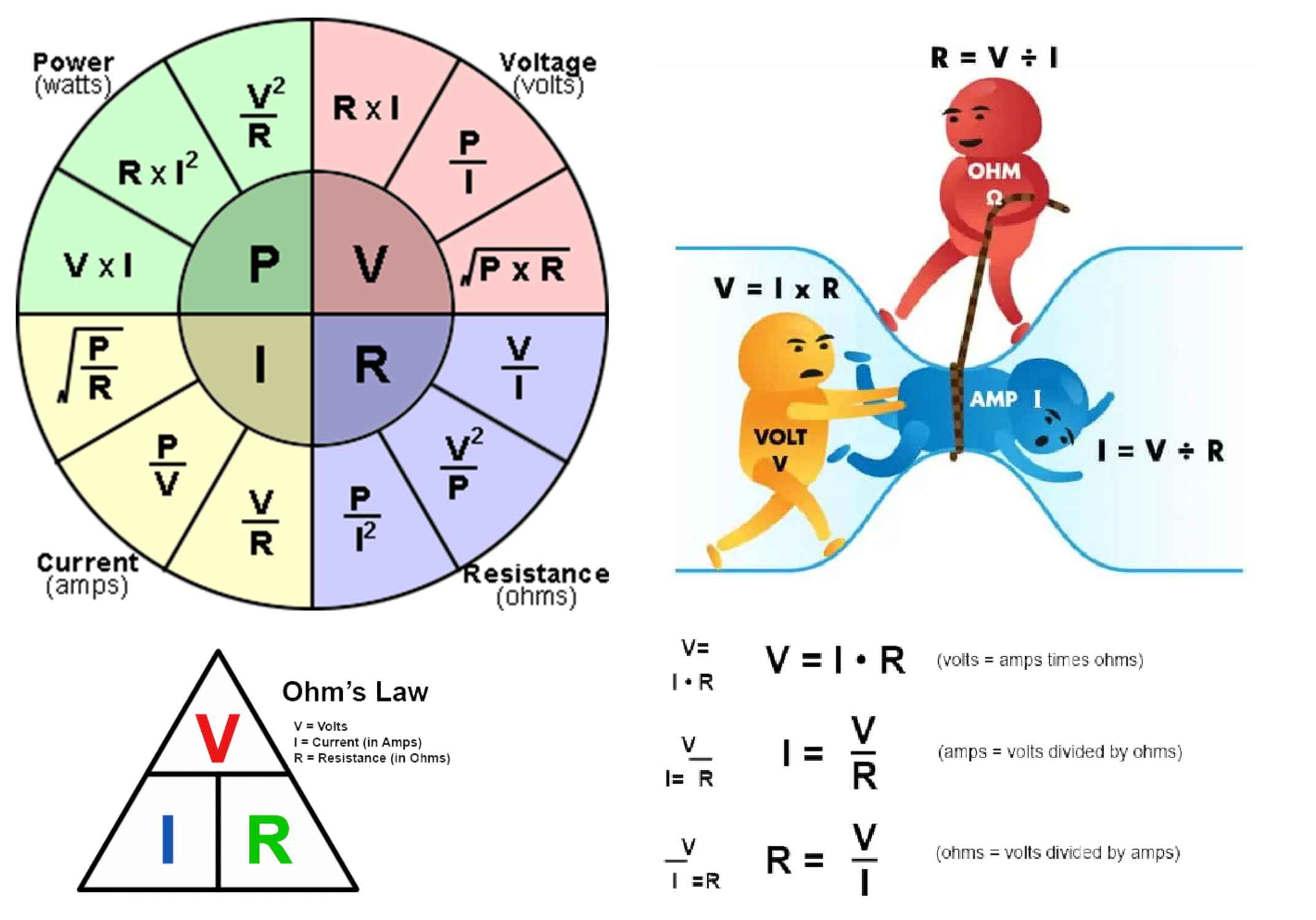
The entire field of electrical engineering, from microelectronics to high-voltage power transmission, rests upon two fundamental principles: Ohm’s Law and Watt’s Law. These laws define the relationship between the four core electrical quantities—Voltage, Current, Resistance, and Power—providing the analytical foundation necessary for circuit design, troubleshooting, and system optimization.
1. Ohm’s Law: The Relationship Between Flow and Opposition
Ohm’s Law, named after the German physicist Georg Simon Ohm, is the most fundamental law governing electrical circuits. It states that the current through a conductor between two points is directly proportional to the voltage across those points and inversely proportional to the resistance between them. This linear relationship is crucial for understanding how a circuit will behave under different conditions. The law is expressed in three primary forms, allowing any one variable to be calculated when the other two are known:
| Variable | Formula | Description | Unit |
| Voltage (V) | V = I x R | The electrical potential difference (measured in Volts) required to push the current through the resistance. | Volts (V) |
| Current (I) | I = V / R | The rate of flow of electrical charge (measured in Amperes). | Amperes (A) |
| Resistance (R) | R = V / I | The opposition to the flow of current (measured in Ohms). | Ohms (Omega)(Ω) |
Practical Application of Ohm’s Law
Ohm’s Law is the daily tool of every electrical professional. In circuit design, it is used to calculate the necessary resistor value to limit current flow to a component, such as an LED. In power systems, it is used to calculate the voltage drop across long transmission lines, where the conductor’s resistance must be accounted for to ensure the end-user receives the correct voltage. For troubleshooting, technicians use Ohm’s Law to identify faults. If a circuit’s measured current is lower than expected at the correct voltage, it indicates an abnormally high resistance, often due to a loose or corroded connection.
2. Watt’s Law: The Power Formula
While Ohm’s Law describes the relationship between the forces and flows within a circuit, Watt’s Law (also known as the Power Formula or Joule’s Law) represents the rate at which electrical energy is transferred or converted into another form, such as heat, light, or mechanical motion. Power is the measure of how much work is being done over time.
Watt’s Law, named after the Scottish inventor James Watt, is expressed as:
P = V x I
Where: P is Power, measured in Watts (W). V is Voltage, measured in Volts (V). I is Current, measured in Amperes (A).
The Interdependence of Power and Flow
The true power of these two laws emerges when they are combined. By substituting the expressions from Ohm’s Law (V = I x R or I = V / R) into Watt’s Law, engineers gain two additional, efficient formulas for calculating power when resistance is the known variable:
| Formula | Derivation | Application |
| P = I2 x R | Substitute V = I x R into P = V x I | Crucial for calculating power loss (heat dissipation) in conductors and resistors. This is the basis for selecting the correct wattage rating for components. |
| P = V2 / R | Substitute I = V / R into P = V x I | Useful for calculating the power consumption of a load when only the voltage and resistance are known. |
This complete set of formulas, often visualized in a “Power Wheel,” allows engineers to calculate any of the four primary electrical quantities given any two others.
The Role in Design and Safety
The combined application of Ohm’s and Watt’s Laws is central to electrical safety and component sizing.
•Component Sizing: When designing a circuit, engineers must use the $P = I^2 \times R$ formula to ensure that a resistor can safely dissipate the heat generated by the current flowing through it. Selecting a resistor with an insufficient wattage rating will cause it to overheat and fail.
•Load Management: In large-scale systems, these laws are used for load management to ensure that the power source and protective devices (like circuit breakers) have the correct capacity to handle the total power demand (P = V x I) without exceeding the current limits (I = V / R) of the wiring.
In conclusion, Ohm’s Law and Watt’s Law are not abstract academic concepts; they are the essential, practical tools that govern the behavior of electricity. Mastery of these two laws is the first step toward understanding and safely manipulating the flow of energy in any electrical system.
References
[1] All About Circuits. Ohm’s Law and Watt’s Law. Provides foundational explanations and practical examples of the combined formulas.
[2] Electronics Tutorials. Ohm’s Law Tutorial and Power in Electrical Circuits. Details the relationship between the four variables and their application in DC circuits.